7 Signs You Need an Electrical Panel Upgrade in Bay County
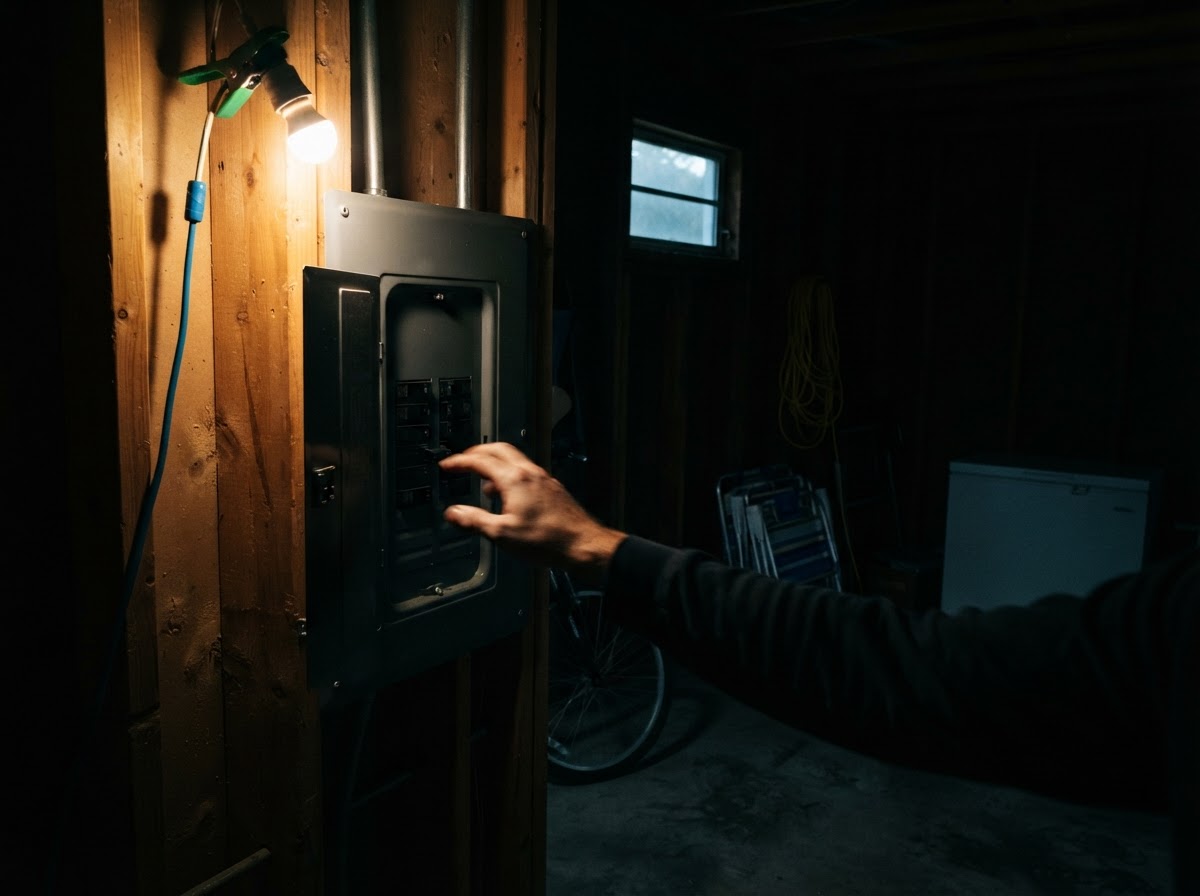
The dryer is running, the microwave is going, and the AC kicks on. Somewhere behind a metal door in the garage a breaker snaps off, and half the house goes quiet. You flip it back on, and for a week nothing happens. Then it happens again.
Most homeowners do not go looking for an electrical panel upgrade. The panel tells them. A breaker that keeps interrupting itself is reporting that the demand on your house has outgrown the equipment installed to serve it.
In Bay County, a 1990s house may now run a heat pump, a tankless water heater, and a charger for an EV in the garage. That is the most common reason an electrical panel upgrade comes up at all, and the warning signs show up well before anything catastrophic does.
This guide covers the seven signs, the panel brands inspectors and insurers flag by name, how to read your main breaker rating, and what the work involves in Panama City Beach. One rule holds throughout: the panel cover stays on. Everything behind that door is licensed work.
What an electrical panel upgrade actually is
An electrical panel upgrade replaces the breaker panel and, in most cases, the service entrance conductors, meter can, and main disconnect that feed it. It is a different job from swapping one bad breaker. It changes the equipment that governs every circuit in the house.
An electrical panel upgrade is the replacement of a home’s main breaker panel, and often the service entrance feeding it, with a larger and safer assembly rated for the amperage the household actually draws.
There are three versions of the work. A like-for-like replacement keeps the same amperage but retires an obsolete or damaged panel. A service change raises capacity, usually from 100 amps to 200 amps, and requires the utility to disconnect and reconnect the drop. A panel plus subpanel adds capacity where the new circuits live, such as a converted garage. A load calculation, not a guess, decides which one your home needs.
The 7 signs you need an electrical panel upgrade
Panels rarely fail without notice. The seven signs below are ordered roughly by urgency, and each one means something specific about what is happening inside the enclosure. Signs two, three, and four justify a call the same day.
- Breakers that trip repeatedly, and the pattern matters. Repeated trips on one circuit usually point at that circuit: too many loads on one bedroom string, or a failing appliance. Trips across several different circuits point at the panel or the service itself. One trip is normal. A weekly trip is a diagnosis waiting to happen, and trips across circuits move an electrical panel upgrade from optional to likely.
- A panel cover, breaker, or wall that feels warm or looks discolored. Heat at the face of a panel means resistance behind it, usually a loose connection or a breaker no longer gripping the bus. Brown streaks around a slot are scorch marks. Urgency: high. Do not open the cover. Call.
- A burning or fishy plastic smell near the panel. Overheated thermoplastic insulation gives off a distinct fishy, chemical odor as it cooks. That smell means a connection has already reached a temperature it was never designed to see. Urgency: immediate.
- Buzzing, humming, or crackling from inside the enclosure. A faint hum from a large appliance is normal. A buzz or an intermittent crackle from the panel is arcing, current jumping a gap it should never cross. Arcing damages the bus bar every time it happens, and a damaged bus is the fastest path to a full electrical panel upgrade.
- Lights that dim when the AC compressor or a well pump starts. A brief flicker at startup is common. A visible sag lasting a second or more, every time, means the service cannot absorb the inrush those motors demand. In Southport and Youngstown homes on wells, it is a reliable early indicator.
- Double-tapped breakers and tandem breakers because the panel is full. A double tap is two wires landed under one screw designed for one. Tandem breakers, sometimes called cheater breakers, squeeze two circuits into a single slot. Both are workarounds for a panel with no room left, and a full panel is a capacity problem an electrical panel upgrade solves properly.
- Fuses, or a 60 to 100 amp service in a house that modernized around it. If the home now has central AC, a heat pump with strip heat, an electric range, and a laundry pair, a 60 amp service was never sized for it. Fuse panels in Callaway and Parker bungalows are still out there. Urgency: schedule the electrical panel upgrade, do not wait for a failure.
The panel brands inspectors and insurers flag by name
Some panels draw attention because of documented problems with their breakers or bus assemblies, not because of brand prejudice. If your label matches one of these, expect it to surface in a home inspection or an insurance review, and expect an electrical panel upgrade to be the recommended remedy.
- Federal Pacific Electric Stab-Lok. Widely reported for breakers that fail to trip on overload. Florida inspectors and insurers flag these on sight, and some carriers will not bind a policy until the panel is replaced.
- Zinsco and Sylvania-Zinsco. Known for aluminum bus bars that can degrade where the breaker clips on, which can leave a breaker energized and unable to interrupt a fault.
- Challenger. Flagged for connection and overheating problems in certain vintages, often with visible heat damage at the bus.
- Split-bus panels with no single main disconnect. Common in 1960s and 1970s construction, these use several main breakers instead of one. Nothing is inherently defective, but there is no single switch to kill all power, which matters in a storm or an emergency.
None of these guarantees a failure tomorrow. What they guarantee is scrutiny, and in Bay County that usually arrives at closing or at renewal. NFPA research for 2015 through 2019 attributes an estimated 32,620 home structure fires per year to electrical distribution and lighting equipment, causing 430 deaths and $1.3 billion in property damage annually. The NFPA electrical safety in the home guidance is worth reading before deciding a flagged panel can wait. Here, an electrical panel upgrade is not cosmetic. It restores overcurrent protection the original assembly can no longer be trusted to deliver.
Read your main breaker before you price an electrical panel upgrade
The largest breaker at the top of the panel is the main, and the number stamped on its handle is your service size. That number decides how much house you can run at once. Reading it is the one piece of homework you can safely do yourself, because it is printed on the breaker face and the panel label, both visible with the cover on.
| Main breaker rating | What it typically supports | Upgrade recommendation |
|---|---|---|
| 60 amp or a fuse block | Lights, receptacles, a window unit, an older range. No margin for central AC. | Replace. Undersized for nearly any Bay County home renovated since the 1990s. |
| 100 amp | A 1,200 to 1,600 sq ft home with central AC, electric range, and water heater, nothing else added. | Evaluate before adding an EV charger, strip heat, a pool pump, or a transfer switch. |
| 125 to 150 amp | A 1,600 to 2,200 sq ft home with a heat pump, electric range, and laundry. One added large load may fit. | Often adequate. A load calculation decides whether an electrical panel upgrade is needed. |
| 200 amp | Most 2,000 to 3,000 sq ft homes: heat pump with strip heat, tankless water heater, EV charger, pool pump, transfer switch. | The practical default for new construction and most service changes. |
| 320 or 400 amp | Large homes, guest suites, converted garages with mini splits, workshops, dock and lift equipment. | By load calculation only. |
The loads that changed this math are specific and recent. A heat pump paired with electric strip heat can pull 40 to 60 amps by itself on a cold January morning, which our heating and heat pump systems work has to account for. A tankless electric water heater can demand more than the entire original service of a 1970s house. A Level 2 EV charger wants a dedicated 40 or 50 amp circuit. Add a pool pump, mini splits in a converted garage, and a generator with a transfer switch, and a 100 amp panel runs out of both slots and headroom. Our post on whether a whole-home generator is worth it on the Gulf Coast explains how that transfer switch ties in during an electrical panel upgrade.
Why an electrical panel upgrade comes sooner near the Gulf
Salt air does not care how new the equipment is. Homes within a few miles of the water see accelerated corrosion on outdoor meter cans, service disconnects, and the aluminum lugs and bus bars inside panels, and corroded connections run hot. That is the local reason an electrical panel upgrade sometimes arrives earlier here than it would inland.
Humidity compounds it. A panel on an exterior wall in Panama City Beach or Mexico Beach sits in salt-laden, high-dew-point air year round, and every cycle of condensation inside the enclosure leaves more chloride on bare metal.
Storms add a third factor. Wind-driven rain finds its way into meter cans and outdoor disconnects, and floodwater that reaches a panel contaminates it permanently, even after it dries. A panel that survived a hurricane is not automatically fine. It is a panel that took an event and was never evaluated after. Our hurricane season home prep checklist for Bay County covers what to check before the next system forms, and rental and second-home owners in Lynn Haven should add the panel to the turnover list.
Permits, licensing, and what the work involves
A service change in Bay County is permitted work. It requires a licensed electrical contractor, an inspection, and coordination with the utility to pull and reset the meter. A quote that skips the permit also skips the inspection that proves the job was done right, and that omission surfaces later at appraisal or closing.
Verify the contractor before work starts. You can verify a licensee through the Florida DBPR in about a minute using the company name or the license number.
Here is what a straightforward electrical panel upgrade looks like on the day. The utility disconnects power at the meter. The old panel, usually along with the meter can and service entrance conductors, comes out. The new panel is set, grounding and bonding are brought to current code, circuits are landed and labeled, and the inspector signs off before the utility reconnects. Expect power out for most of a working day, commonly six to eight hours, longer if the mast or lateral is replaced.
Plan around it. Move perishables and charge any powered medical equipment, and say so when booking if someone in the home depends on it. Our electrical services in Panama City Beach page covers what an electrical panel upgrade evaluation includes.
Frequently asked questions
How much does an electrical panel upgrade cost?
Cost depends on the service size, whether the meter can and service entrance are replaced, whether the run is overhead or underground, and what the permit and utility coordination require. A like-for-like swap sits at the low end. A full 100 amp to 200 amp service change sits considerably higher. Ask for a written quote after a load calculation.
Can I replace a breaker myself instead of getting an electrical panel upgrade?
No. Opening a panel exposes bus bars and line-side lugs that stay energized even with the main breaker off, because the utility feed lands ahead of that switch. Homeowner steps stop at observing symptoms, resetting a tripped breaker once, and reading the panel door label. If it trips again after one reset, call a licensed electrician.
How do I know if I have a Federal Pacific or Zinsco panel?
The brand is printed on the panel door, the inside of the cover, or the label listing circuit ratings, all readable without removing anything. Federal Pacific panels often say Stab-Lok. Zinsco breakers commonly have colored handles. Photograph the label and send it over. Identification never requires opening the enclosure, and should not be attempted that way.
Do I need a 200 amp service to add an EV charger?
Not always. A Level 2 charger needs a dedicated 40 or 50 amp circuit, and whether your service can carry it depends on your other loads and available slots. Some 150 amp homes accommodate one with load management. Many 100 amp homes cannot. A load calculation answers it, and it is the first step of any charger install.
Will my insurance company make me replace my panel?
Some Florida carriers do decline or non-renew policies over Federal Pacific Stab-Lok, Zinsco, and certain fuse services, and others require documentation of replacement at binding. Policies vary by carrier and by year. If a four-point inspection flagged your panel, ask your agent exactly what the carrier requires, then have a licensed contractor quote the work to that specification.
My panel got wet during a storm. Does it have to be replaced?
Probably, and it should be evaluated before it is re-energized. Water carrying salt or debris leaves conductive residue on bus bars and breaker contacts that keeps corroding after everything looks dry. Breakers that have been submerged are not rated for reuse. In Mexico Beach and Springfield, a post-storm electrical panel upgrade is routine work after a major event.
Get a straight answer on your panel
If breakers keep tripping, the panel is full, or an inspector flagged the brand on the label, an evaluation tells you whether you need an electrical panel upgrade or a smaller repair. Frank Wood & Son Services has served Panama City Beach and Bay County since 1985, and our licensed electricians handle panel evaluations, service changes, and generator tie-ins across Panama City, Lynn Haven, Callaway, Parker, Springfield, and Mexico Beach.
Call (850) 234-2168 or reach us through the contact page to schedule an electrical panel upgrade assessment. Family-owned, Veteran-owned, licensed and insured, with 24/7 emergency service for when the smell or the heat means it cannot wait until Monday.