Heat Pump Not Heating? What to Check Before You Call
It is the second week of December, the first real cold front has pushed through Panama City Beach, and the thermostat reads 70 while the house feels closer to 64. You hold a hand over the nearest supply vent. Air is moving, but it feels lukewarm. Almost cool.
Here is the part almost nobody explains to Gulf Coast homeowners: a heat pump not heating is sometimes a heat pump doing exactly what it was engineered to do. Supply air from a heat pump normally measures about 90 to 100 degrees, below your body temperature, so it feels cool against your skin even while the house climbs toward setpoint.
There is also a real fault list, and December is when it surfaces. This guide separates a heat pump not heating from one behaving normally, and shows where the line sits between a homeowner fix and a licensed technician.
Start here: is your heat pump not heating, or heating as designed?
Before writing it off as a heat pump not heating, take a temperature reading. Hold a thermometer at a supply vent for two minutes with the system in HEAT. If it reads 90 to 100 degrees, and 20 to 30 degrees warmer than your return grille, the equipment is making heat.
A heat pump does not burn fuel. It moves heat from outdoor air into your house, so its supply air runs about 90 to 100 degrees, warm to a room but cooler than your 98.6 degree hand.
A gas furnace pushes 120 to 140 degree air in short bursts. A heat pump pushes gentler air for far longer stretches. A real share of heat pump not heating calls in Bay County turn out to be correctly working equipment meeting an expectation a furnace set years ago.
Two honest exceptions. If the house is not reaching setpoint after several hours, or supply air measures under about 85 degrees, that is a heat pump not heating in the true sense.
Defrost mode: why the outdoor unit steams and the air turns cool
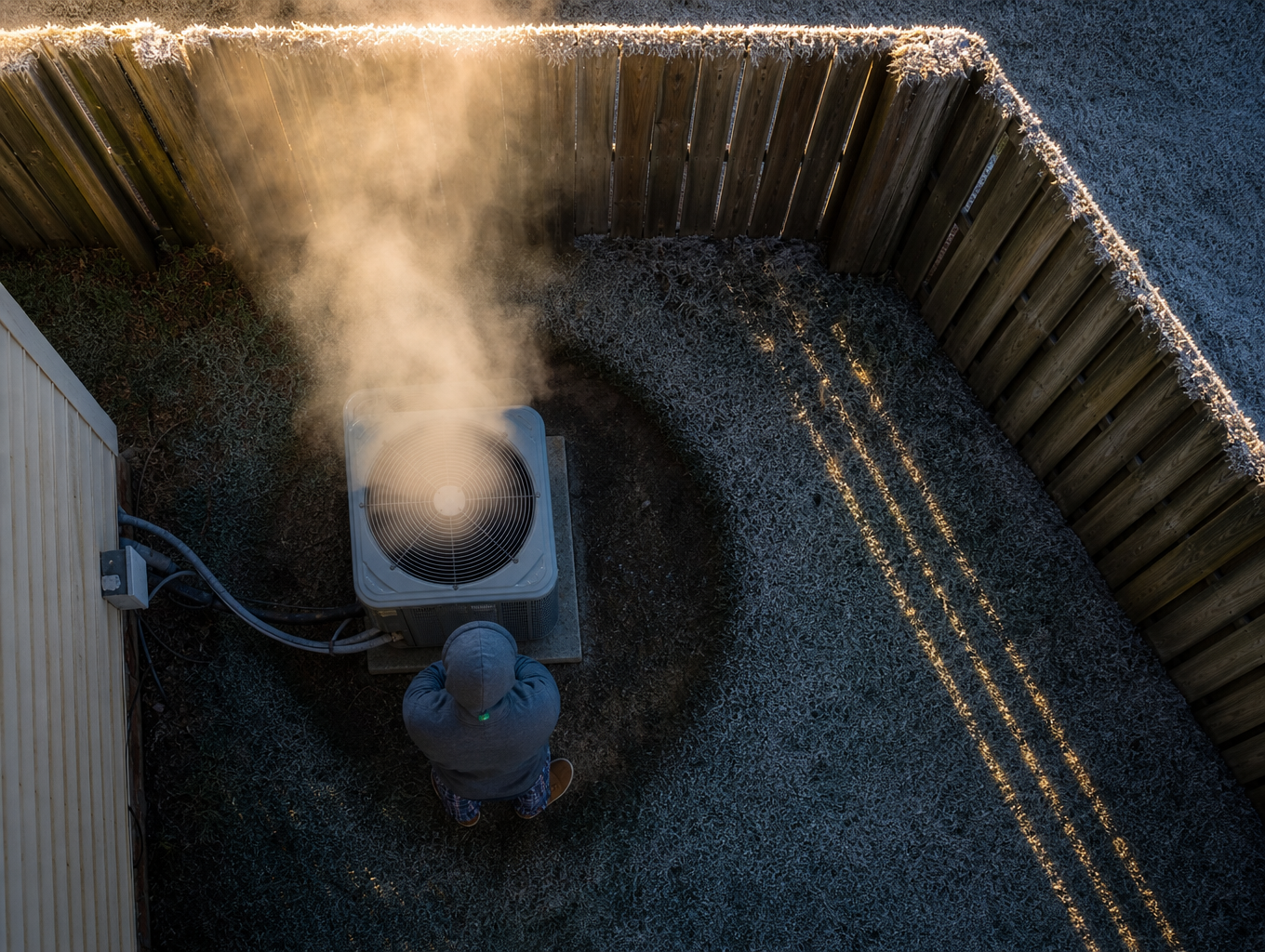
On a damp 38 degree morning, frost forms on the outdoor coil because that coil runs colder than the outside air. The system notices, reverses itself for a few minutes, and melts the frost off. A heat pump not heating for ten minutes on a frosty morning is usually just this.
During defrost you will see steam rolling off the outdoor unit, hear a loud whoosh as the reversing valve shifts, and feel indoor air go cool briefly. Most systems run the heat strips so it does not turn genuinely cold.
A normal defrost cycle runs about 5 to 15 minutes and ends on its own. A heat pump not heating between constant defrost cycles, or an outdoor unit encased in ice that never clears, is not normal. A failed defrost board, a bad sensor, or low refrigerant charge will do it, and sorting that out takes gauges and a meter.
What AUX and EM HEAT actually mean on your thermostat
Almost every heat pump in Panama City Beach has electric resistance strips in the air handler, the same technology as a toaster. They are backup, not the main event. AUX means the system decided it needed those strips to keep up. EM HEAT means you told it to shut the compressor off and run on strips alone.
The compressor is the efficient half of the machine. According to the U.S. Department of Energy, an air-source heat pump can deliver up to three times more heat energy than the electrical energy it consumes, and DOE cites roughly 3,000 kWh (about $459) in annual savings versus electric resistance heat. Strip heat gives you one unit of heat per unit of electricity. No multiplier.
Leave the switch on EM HEAT through a cool week and comfort will seem fine. The bill is where you find it, often double or triple a normal heating month.
Use EM HEAT only when the compressor has actually failed and you are waiting on a technician. AUX coming on during a 35 degree morning is normal staging. AUX glowing at 62 degrees outside means a heat pump not heating on its efficient stage, which is worth a call.
Strip heat pulls serious amperage, which is why an older panel trips when the strips engage. If breakers complain when the weather turns, read our guide to the signs you need an electrical panel upgrade.
Five checks before you call
Run these in order. They take about ten minutes and they resolve a meaningful share of heat pump not heating calls without anyone coming out.
- Confirm the thermostat mode. It must be on HEAT. A thermostat left on COOL since October blows room-temperature air all day, which is the single most common heat pump not heating complaint. Set the target three degrees above the room reading.
- Check thermostat power. Swap the batteries. If a hardwired smart thermostat is blank, the cause is often a missing C-wire or a tripped condensate float switch cutting the control circuit.
- Pull the filter and look at it. A clogged filter starves airflow, drops supply temperature, and can freeze a coil. DOE notes that replacing a dirty, clogged filter with a clean one can cut energy consumption by 5 to 15 percent.
- Walk outside. Clear leaves, pine straw, and mulch back two feet on all sides. Remove any cover put on for the season. Confirm the fan spins and the coil is not packed in ice.
- Check both breakers. A heat pump has two, one for the air handler and one for the outdoor condenser. Reset a tripped breaker once, firmly off then on. If it trips again, leave it off and call.
If a heat pump not heating survives all five, the next step is instruments, not guesses.
The real fault list, ordered by how likely it is
Most causes of a heat pump not heating are airflow or electrical. A few live in the refrigerant circuit and require a license to touch.
| Symptom | Likely cause | Homeowner or technician |
|---|---|---|
| Lukewarm air, house slowly warming | Normal supply air, 90 to 100 degrees | Homeowner, no action needed |
| Steaming outdoor unit, brief cool air | Normal defrost cycle | Homeowner, wait 15 minutes |
| Room-temperature air all day | Thermostat on COOL or fan set to ON | Homeowner |
| Thermostat blank | Dead batteries, lost C-wire, tripped float switch | Homeowner, then technician |
| Weak airflow at every vent | Dirty filter or blocked return | Homeowner |
| Blower runs, outdoor unit silent | Tripped breaker, bad contactor or capacitor | Reset once, then technician |
| Outdoor fan hums but does not spin | Failed capacitor or seized fan motor | Licensed technician |
| Coil buried in ice that never clears | Failed defrost board or sensor, low charge | Licensed technician |
| Cool air only, system runs constantly | Failed or stuck reversing valve | Licensed technician |
| Long run times, ice on the small line | Low refrigerant charge, almost always a leak | Licensed technician |
| Breaker trips when strip heat engages | Undersized circuit or panel capacity | Licensed electrician |
Anything in the bottom half is a diagnosis, not a guess, and a heat pump not heating for those reasons needs instruments. A reversing valve failure looks identical to three other problems until someone puts instruments on it, so our heating services trucks carry the common capacitors, contactors, and control boards.
The Panama City Beach factor
Your heat pump spends eight or nine months a year cooling the house and maybe fifteen days truly heating it. Heating mode is a stranger here. The reversing valve sits in one position from March to November, the defrost board never gets exercised, and the heat strips collect dust.
Then the first 35 degree night arrives and every idle component is asked to perform at once. That is why heat pump not heating calls in Panama City Beach, Lynn Haven, Callaway, and Parker cluster into the same 48 hour window, and why the wait is longest on the night you need help most.
Nobody here forgot the recent example. In January 2025, a rare winter storm set Florida snow records across the Panhandle. Milton picked up about 9.8 inches of snow, Pensacola recorded 8.9 inches and broke an 1895 record, and Duke Energy reported roughly 15,000 customers without power at the peak. Equipment that had not run in heat mode for a year was suddenly all that stood between families and a freezing house.
The lesson costs nothing. Test your heat in October, not January. Run it thirty minutes on a mild afternoon and confirm 90 to 100 degree air. Finding a heat pump not heating on a 72 degree Tuesday in fall is a scheduled repair. Finding it at 11 p.m. during a hard freeze is an emergency.
Salt air is doing quiet damage the whole time
Homes in Panama City Beach, Mexico Beach, and beachfront Bay County pay a corrosion tax inland homes do not. Salt-laden air eats the aluminum fins of the outdoor coil and pits the contacts inside contactors and disconnects.
A corroded contactor is one of the most common reasons an outdoor unit sits dead while the indoor blower runs happily, which is a heat pump not heating for a purely electrical reason. Our guide to salt air corrosion and your AC applies to heating season too, because it is the same outdoor unit doing both jobs.
What to do in the meantime, safely
With a heat pump not heating and a technician on the way, EM HEAT is the right short-term move. It is expensive per hour, but it is safe and it will keep the house livable overnight. Switch back to HEAT once the repair is done.
Space heaters are the other stopgap, and they are where winter house fires start. A few non-negotiables:
- Keep three feet of clearance on all sides, especially from bedding, curtains, and upholstered furniture.
- Plug the heater directly into a wall outlet. Never an extension cord, power strip, or surge protector.
- Turn it off when you sleep and when you leave the room.
- Never use an oven, range, grill, or generator indoors for heat. That is a carbon monoxide risk, not a heating plan.
- If an outlet or breaker warms up, unplug the heater and stop using that circuit.
Older homes in Springfield, Callaway, and the beach rental corridor were never wired for four space heaters at once. Spread the load across circuits and have our electrical services team evaluate the panel once heat is restored.
How to keep next winter from starting with a heat pump not heating
Preventing a heat pump not heating is cheap relative to the failure it avoids.
- Change the filter on a schedule, every one to three months depending on the filter and pets.
- Run a heat test in October. Thirty minutes, one thermometer, done.
- Keep the outdoor unit clear. Two feet on all sides, no covers, no mulch against the base.
- Book a fall tune-up. A technician checks the reversing valve, defrost cycle, strip heat amp draw, contactor, and charge before weather forces the issue.
- Know the age of the system. Most heat pumps here run 10 to 15 years, and salt air pulls that toward the low end.
The maintenance that prevents a heat pump not heating in December is the same maintenance that keeps July comfortable. It is one machine running in two directions.
Frequently asked questions
Why does my heat pump blow cool air when the heat is on?
Heat pump supply air normally runs about 90 to 100 degrees, cooler than your 98.6 degree skin, so it feels lukewarm even while warming the house. Cool air is also normal during a defrost cycle. Many reports of a heat pump not heating are exactly this. If supply air stays under 85 degrees, call a technician.
Is it bad to run emergency heat all winter?
Yes, mostly for your budget. Emergency heat bypasses the efficient compressor and runs electric resistance strips alone, producing one unit of heat per unit of electricity instead of the multiplier a heat pump gives you. A month on EM HEAT can double or triple a normal Bay County power bill. Use it only while awaiting repair.
How long should a heat pump defrost cycle last?
A normal defrost cycle lasts about 5 to 15 minutes and ends automatically. You will see steam, hear the reversing valve shift with a loud whoosh, and feel briefly cooler indoor air. If the outdoor unit stays iced over, defrosts constantly, or never clears after an hour, the defrost control, sensor, or charge needs attention.
Why is my outdoor unit covered in ice?
Light frost on the coil is normal in cold, damp weather, and the defrost cycle clears it. Solid ice that never melts points to a failed defrost board or sensor, a blocked coil, a bad fan motor, or low refrigerant charge. Do not chip it off. Switch to EM HEAT and schedule a licensed technician.
Can a dirty filter really stop a heat pump from heating?
It can. Restricted airflow lowers supply temperature, causes long run times, trips safety limits, and in bad cases freezes the indoor coil. DOE reports that swapping a clogged filter for a clean one can cut energy use by 5 to 15 percent. It is the cheapest fix for a heat pump not heating well.
When should I call instead of troubleshooting?
Call once the thermostat, filter, breakers, and outdoor unit have been checked and a heat pump not heating is still the situation. Call immediately for a breaker that trips twice, a burning smell, ice that will not clear, a fan that hums without spinning, or any home with infants or medical equipment during a freeze.
Get the heat back on in Panama City Beach
If you have worked through the checks above and still have a heat pump not heating your home, the next step is a real diagnosis. Frank Wood & Son Services has served Panama City Beach and Bay County since 1985. We are family-owned, Veteran-owned, licensed and insured, and we answer the phone for emergencies 24/7.
Call (850) 234-2168 or schedule service online. Capacitor, contactor, defrost board, or reversing valve, a heat pump not heating on the first cold night is a problem we solve every December in Panama City Beach, Lynn Haven, Callaway, Parker, Springfield, and Mexico Beach.