Salt Air Corrosion and Your AC: A Panama City Beach Guide
The house sits two blocks off Front Beach Road. The condenser outside is eight years old and looks a decade older: the aluminum fins have gone chalky white, the cabinet screws are weeping rust stains down the panel, and there is a fine grit on every surface that never quite rinses away. Nobody abused this unit. It simply lives near the Gulf.
If you own property in Panama City Beach, somebody has probably told you that salt air corrosion will take years off your air conditioner. That is true. It is also far more specific, more predictable, and more manageable than the vague warning makes it sound.
This guide covers what salt air corrosion actually is at the metal level, how far inland it reaches, what it attacks besides the condenser, and which maintenance habits genuinely slow it down versus which ones just feel productive.
What salt air corrosion actually is at the metal level
Salt air corrosion is not rust in the ordinary sense. It is chloride attack: microscopic sea salt particles ride onshore in aerosol form, settle on metal, and pull moisture out of humid Gulf Coast air. That salty film sits against the surface and dissolves the protective oxide layer that normally keeps aluminum and copper stable.
Salt air corrosion is the breakdown of metal caused by airborne sea salt, where chloride particles settle on coils, cabinets, and connections, hold moisture against the surface, and eat through protective oxide layers far faster than inland air would.
Salt air corrosion shows up in three distinct failure patterns on coastal equipment, and they do not look alike.
Chloride attack on aluminum fins
The aluminum fins on a condenser coil are thin, roughly the thickness of a few sheets of paper. Chloride pitting eats holes through them and turns the surface into a white powder that flakes off when you brush it.
Fin loss rarely causes a dramatic breakdown. It causes a slow decline: less surface area for heat transfer, higher head pressure, longer run times, and a compressor working harder every season.
Galvanic corrosion where two metals meet
Almost every condenser coil joins copper tubing to aluminum fins, and a salt film is an excellent electrolyte. When two dissimilar metals touch in the presence of an electrolyte, the less noble metal gives up electrons and sacrifices itself.
Aluminum loses that contest to copper every time. This is why the copper-to-aluminum joint is usually the first place a coastal coil fails, and why salt air corrosion often shows up as a ring of damage right where the tube passes through the fin.
Formicary corrosion, the ants nest pattern
Formicary corrosion is the quiet one. It attacks copper tubing from the inside out, carving branching microscopic tunnels that look like an ant colony under magnification. It needs oxygen, moisture, and organic acids, and coastal environments with heavy humidity supply all three.
The result is a pinhole refrigerant leak with no visible damage on the outside of the tube. If a technician says a young coil is leaking and cannot point to a dent or a rub-out, this form of salt air corrosion is the likely explanation.
How far inland does salt air corrosion actually reach
Farther than most people assume. Salt aerosol does not stop at the dune line. Prevailing south and southwest winds off the Gulf carry chloride particles miles inland, and the flat terrain across Bay County gives them nothing to break against.
Measurable chloride deposition drops sharply in the first quarter mile, then tapers gradually. A home in Callaway or Lynn Haven still sees real salt air corrosion, just at a fraction of the rate a beachfront condo does. Storm events matter too: a strong onshore blow during hurricane season can push salt well past the usual gradient in a single day.
Here is a practical way to think about where your property falls.
| Distance from the Gulf | Salt air corrosion risk | Expected condenser lifespan | Recommended rinse frequency |
|---|---|---|---|
| Beachfront to 1/4 mile | Severe | 7 to 10 years | Every 2 to 4 weeks, year round |
| 1/4 mile to 1 mile | High | 9 to 12 years | Monthly, year round |
| 1 to 3 miles | Moderate | 11 to 14 years | Monthly March through October |
| 3 to 7 miles | Low to moderate | 12 to 16 years | Quarterly, plus after named storms |
| Beyond 7 miles | Low | 13 to 18 years | Twice a year with annual service |
Those ranges assume the equipment is otherwise maintained. An unrinsed beachfront condenser can fail in five years. A rinsed one in the same spot can reach eleven. That gap is the whole argument for treating salt air corrosion as a maintenance item.
Salt air corrosion is not only an air conditioner problem
Your condenser is simply the most exposed piece of metal you own, so it fails first and loudly. The same chloride load is working on everything else outside the house at the same time.
Watch these six items on any coastal property:
- Outdoor electrical disconnects. The pull-out disconnect beside the condenser is a plastic box full of bare copper and aluminum. Salt air corrosion builds resistance on those blades, resistance builds heat, and heat eventually cooks the connection.
- Panel lugs and breaker terminals. Even inside a garage, salt air corrosion reaches the panel. Corroded lugs create high-resistance connections that show up as flickering lights or warm breakers. That is work for a licensed electrician. Our electrical services team checks lug torque and condition during a panel inspection.
- Water heater flue caps and draft hoods. Galvanized flue components on gas water heaters rust through from the outside in, and a compromised flue is a combustion safety issue.
- Exterior hose bibbs and irrigation valves. Chrome and brass pit, stems seize, and the valve you need during hurricane season is the one that will not turn.
- Pool equipment. Pump housings, heater cabinets, and heat pump coils sit in the same salt load, often closer to the water than the AC does.
- Ductless mini split outdoor units. Popular for garages and beach cottages in Parker and Mexico Beach. Their tighter fin spacing traps salt and clogs faster.
How to slow salt air corrosion down without wrecking your equipment
The single most effective defense against salt air corrosion is rinsing the outdoor coil with plain fresh water on a schedule. Done correctly it removes the chloride film before it has time to work. Done incorrectly it flattens fins and makes the problem worse.
Do it in this order:
- Shut off power at the disconnect beside the unit, and at the breaker if you want to be certain. Never spray a live condenser.
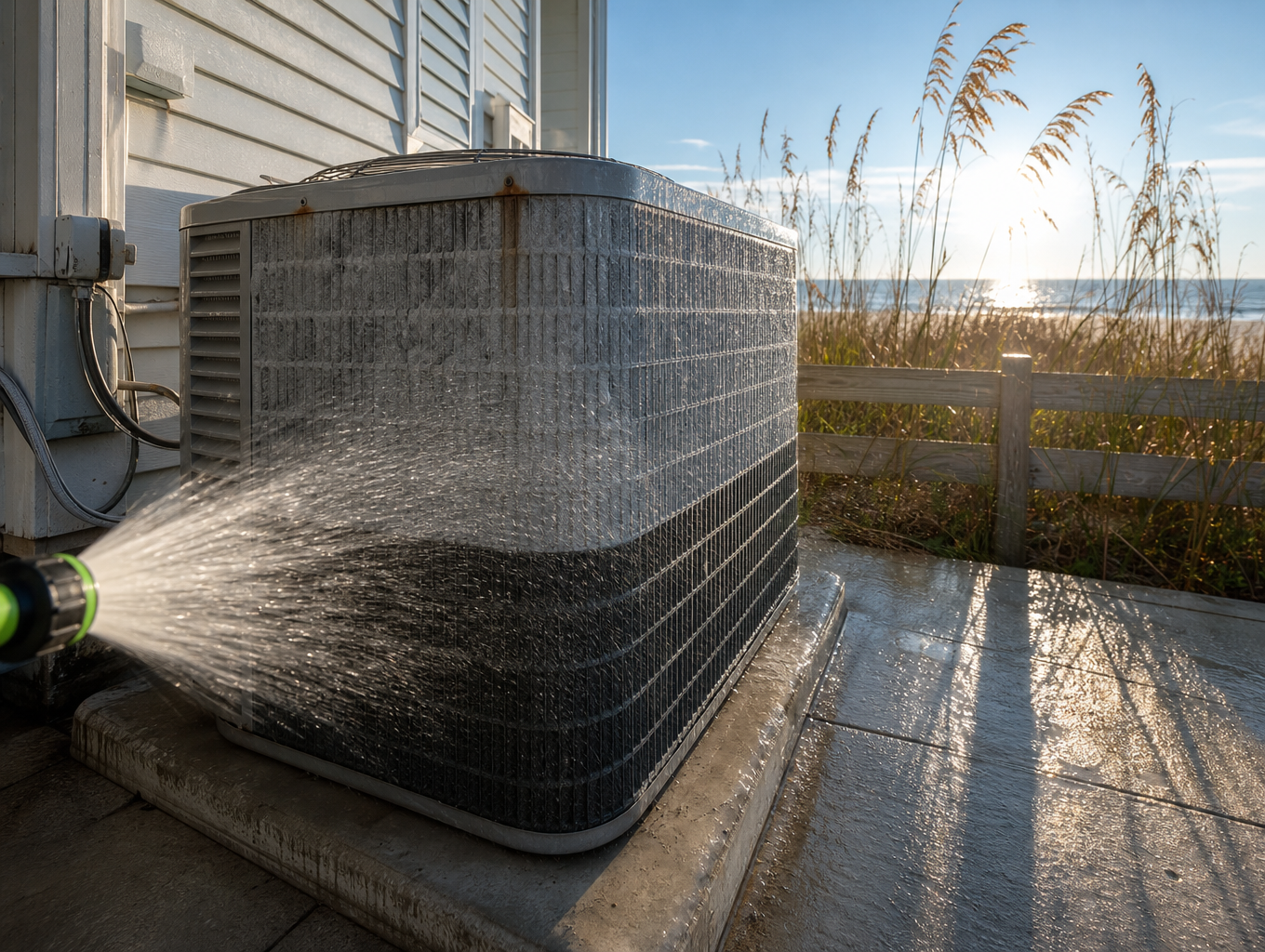
- Rinse from the inside out. Remove the top grille if your unit allows it and direct water outward through the coil, the opposite direction from normal airflow. Rinsing from outside pushes salt and debris deeper into the fin pack.
- Use a garden hose with a gentle shower or fan pattern. No pressure washer, no jet nozzle. Condenser fins deform at surprisingly low pressure, and bent fins block airflow permanently unless someone combs them straight.
- Let it run for several minutes per side. Dissolving a salt film takes volume and dwell time, not force.
- Rinse the cabinet, the pad, and the disconnect box exterior while you are there. Let everything dry before restoring power.
Beyond rinsing, a few decisions at installation time matter more than anything you do later. Factory coastal-coated coils, applied by the manufacturer before assembly, outperform field-applied coatings because coverage is complete and cure quality is controlled. Ask specifically whether a quoted unit has a factory coastal package or an aftermarket spray.
Pad placement helps too. Setting the condenser on the north or east side of the house, out of direct onshore wind, cuts salt air corrosion measurably. Elevating the pad above grade keeps sandy soil and storm water off the base rails, which also buys flood clearance in low-lying parts of Bay County.
Inside the house, keep filters clean so the system is not straining against a corroding outdoor coil at the same time. The Department of Energy recommends replacing filters every month or two during cooling season, and notes that swapping a clogged filter for a clean one can lower energy use by 5 to 15 percent. For a full list of what you can safely handle yourself, see our guide to maintenance tasks you can do yourself. On the water heater side, replacing a spent sacrificial anode rod every three to five years lets a cheap piece of magnesium corrode instead of the tank lining.
What lifespan you should honestly expect near the water
A well-maintained central AC inland in Florida commonly reaches 15 years. On the beach, plan for 8 to 12. That is not a sales tactic, it is a materials reality, and it should shape how you budget rather than how much you worry.
Framed honestly, salt air corrosion costs a beachfront homeowner roughly one system replacement per generation more than an inland neighbor. Planning for that is cheaper than being surprised by it in July. If a replacement is on your horizon, our breakdown of what AC replacement actually costs in Panama City Beach walks through real numbers.
Efficiency deserves a mention too. ENERGY STAR notes that heating and cooling can account for as much as half of a home’s energy use, and a coil losing surface area to salt air corrosion pushes that share higher every year it goes unaddressed.
What a real coastal maintenance visit should include
A generic tune-up checklist written for Atlanta does not account for salt air corrosion. A coastal visit should go further, and you are entitled to ask what is on the list.
Expect a technician to inspect the coil for fin loss and pitting, check the copper-to-aluminum joints for galvanic damage, leak-test rather than just top off refrigerant, open and inspect the disconnect for corroded blades, check contactor points for pitting, verify the condenser pad and elevation, and document the coil condition with photos so you can track the trend. Our air conditioning services include that coastal-specific inspection.
The second home and rental property problem
Panama City Beach has a large share of second homes and short-term rentals, and salt air corrosion punishes both harder than it punishes a full-time residence. Nobody is rinsing a coil at a house that sits empty from November to March.
Three habits help. First, schedule the rinse as a recurring service rather than relying on whoever happens to be in town. Second, ask your cleaning or property management company to photograph the condenser quarterly so you can spot fin whitening early. Third, do not let a unit sit completely idle for months. Running the system periodically keeps the fan moving air across the coil and keeps refrigerant circulating.
High turnover creates a second problem: filters. A rental in Panama City or Springfield through peak season may need a filter change monthly, and a strained system paired with a coil already losing fins to salt air corrosion is how a ten-year unit becomes a six-year unit.
Frequently asked questions
How far from the beach does salt air actually damage an AC?
Damage is severe within the first quarter mile and remains meaningful out to roughly three miles, because prevailing Gulf winds carry salt aerosol well inland over flat terrain. Homes in Lynn Haven and Callaway see moderate exposure. Beyond about seven miles, corrosion risk drops close to inland levels, though strong onshore storms can push salt further in a single event.
Can I pressure wash my AC condenser to clean off salt?
No. Condenser fins are thin aluminum and bend at pressures far below what a pressure washer produces, and bent fins block airflow permanently. Use a garden hose with a gentle fan or shower pattern instead, spraying from the inside of the coil outward with the power off at the disconnect. Volume and time do the work, not force.
Are coastal coated AC units worth the extra cost?
Near the water, generally yes. A factory-applied coastal coating typically adds a modest percentage to equipment cost and can add several years of coil life in a severe exposure zone. Factory coatings outperform aftermarket sprays because coverage and cure are controlled during manufacturing. Farther than a few miles inland, the payback becomes harder to justify.
How often should I rinse my AC if I live on the beach?
Every two to four weeks year round within a quarter mile of the Gulf, and monthly out to about a mile. Salt deposition does not pause in winter, so this is not a summer-only task. If your property sits vacant for stretches, put the rinse on a recurring service schedule rather than trusting an irregular visit.
Does salt air corrosion void my HVAC warranty?
Not usually, but many manufacturer warranties exclude damage from corrosive environments or require documented maintenance. Keep records of rinses and professional service visits, and ask your installer directly how the warranty treats coastal exposure before you buy. Registering the equipment on time also matters, since unregistered systems often drop to a much shorter base warranty term.
What is the first sign of salt air corrosion I can spot myself?
Look for a chalky white powder on the aluminum fins and rust streaks running down from cabinet screws and panel seams. Both appear well before performance drops. Also check whether the fins look flattened or matted in patches, which restricts airflow, and glance inside the disconnect box for green or white buildup on the metal blades.
Get ahead of salt air corrosion before it costs you a system
Salt air corrosion is not a reason to dread coastal ownership. It is a known variable with a known answer: rinse on schedule, specify the right equipment, and have someone who understands Gulf Coast conditions look at the whole system rather than just the thermostat.
Frank Wood & Son Services has worked on Bay County homes since 1985, from Panama City Beach out to Mexico Beach and Youngstown. We are family-owned, Veteran-owned, licensed and insured, and available 24/7 for emergencies.
Call (850) 234-2168 or contact us to schedule a coastal AC inspection, and find out how much life your current system has left.