What EV Charger Installation Takes in a Panama City Beach Home
You just brought home an electric car, and the first real question is not range. It is how you will charge it in your own garage without tripping breakers or paying for more than you need. In Panama City Beach, the answer comes down to four things: how you drive, what your panel can spare, where the car parks, and how the Gulf weather treats the gear.
EV charger installation means adding a properly sized, permitted electrical circuit and safety-certified charging equipment so your electric vehicle charges at home, most often on a 240-volt Level 2 setup.
Some drivers need far less than the dealership suggested. Others learn their older panel has no room left. Here is how it plays out in a Bay County home.
Do you need a Level 2 charger, or will a regular outlet do?
Plenty of drivers get by on Level 1, the cord that came with the car plugged into a standard 120-volt outlet overnight. A Level 2 charger on a 240-volt circuit earns its keep when you drive longer distances, own a large battery, or share one garage between two electric cars.
The U.S. Department of Energy says much the same in its Alternative Fuels Data Center guide to charging at home. Many drivers meet daily needs charging overnight on Level 1, and Level 2 suits longer commutes or bigger batteries.
Before you book EV charger installation, think about your real week. Short trips around Pier Park and Front Beach Road add only a modest number of miles a day, and a slow overnight charge covers that. A weekday commute to Panama City, Lynn Haven, or past Callaway, plus errands at night, can leave Level 1 behind by Thursday.
- Level 1: standard 120-volt outlet, slow, little or no setup, fine for short daily driving.
- Level 2: 240-volt dedicated circuit, several times faster, needs a permitted electrical project.
Our honest advice is to live with Level 1 for a few weeks if your outlet is in good shape and not shared with a freezer or shop compressor. If the car is full every morning, you may not need EV charger installation at all.
One caution. An outlet feeding a car for eight or ten hours gets a real workout. Have an old garage receptacle checked first.
What does EV charger installation involve, step by step?
A proper job follows a set order: load calculation, panel check, wire route, circuit and charger, permit, and inspection. Skipping the first step is where most bad installs start.
- Load calculation. An electrician totals what the house already draws, including the AC, water heater, range, dryer, and pool pump, to see what is left for a car.
- Panel review. We check the panel’s rating, condition, and physical space for a new two-pole breaker.
- Location and route. We find where the charge port lands when you park and the shortest safe wire path from the panel.
- Circuit and equipment. We run a dedicated circuit sized to the charger, commonly a 40 or 50 amp circuit for Level 2, then hardwire the unit or install a receptacle.
- Permit and inspection. The work is permitted and inspected through the local building department.
The load calculation sounds like paperwork. It is not. A Level 2 charger pulls a steady, heavy load for hours, often at night while your AC is still running in August, and that combination is exactly what an undersized panel cannot handle. That is why we never start EV charger installation by guessing.
Should you hardwire the charger or use a 240-volt outlet for EV charging?
Both work. A hardwired wall unit is the cleaner, more durable choice for a charger that stays put, while a NEMA 14-50 receptacle lets you unplug the charger and take it with you.
The NEMA 14-50 receptacle route
A NEMA 14-50 is the same style of 240-volt receptacle used for many RVs and some ranges, and plenty of portable chargers plug straight into it. If you move or swap cars, the charger goes with you.
A receptacle under continuous heavy load night after night builds heat at the contacts, and cheaper receptacles wear and loosen with repeated plugging. Current code generally calls for GFCI protection on that garage receptacle, and some chargers have their own ground fault protection, so the two can disagree and cause nuisance trips. Use an industrial-grade receptacle and a charger listed for plug-in use on a 240-volt outlet for EV charging.
The hardwired route
For a permanent EV charger installation, hardwiring is usually our pick. No receptacle to wear, no plug to work loose, fewer GFCI headaches, and many wall units allow a higher charging setting when hardwired. The catch is that it stays with the house.
Decision table for EV charger installation at home
| Your situation | Better fit | Why |
|---|---|---|
| Short daily driving, healthy outlet nearby | Level 1 on a standard 120-volt outlet | No new circuit; overnight charging may cover your miles |
| Long commute or large battery, staying for years | Hardwired Level 2 charger | Most durable, no receptacle wear |
| Renting or likely to move soon | Level 2 on a NEMA 14-50 receptacle | Charger can leave with you; use an industrial-grade receptacle |
| Charger mounted on an outside driveway | Hardwired, outdoor-rated unit | Fewer exposed contacts for salt air and rain |
| Panel already near its limit | Load management or panel upgrade | Avoids overloading the service at peak AC hours |
| Condo or townhome shared garage | Association approval first | Associations often control metering and mounting |
Can your electrical panel handle EV charger installation?
Maybe. A load calculation answers that, not a count of empty breaker slots. If the numbers come up short, the fix is usually a panel upgrade, a subpanel, or a load management device that shares capacity between the charger and other big appliances.
Many older homes in Panama City Beach and across Bay County have smaller electrical services. Add central AC, an electric water heater, a range, a dryer, and a pool pump, and some panels are working hard before a car shows up. The Department of Energy notes a qualified electrician can add circuits when a home lacks capacity, but the service still has to support them.
- Load management. A device slows the charger when the house is busy, which often avoids a full service upgrade.
- Subpanel. Useful when the main panel has capacity but no room, or the garage is far from the main panel.
- EV panel upgrade. Replacing the panel, sometimes with a larger service from the utility, when the house needs more capacity.
- Smaller circuit. A lower amperage Level 2 circuit can still cover your driving without straining the panel.
If your panel is old, warm, buzzing, or crowded, read the signs you need an electrical panel upgrade before you buy a charger. EV charger installation on a tired panel is a project to do once and do right.
Where should the charger go in a Bay County garage or driveway?
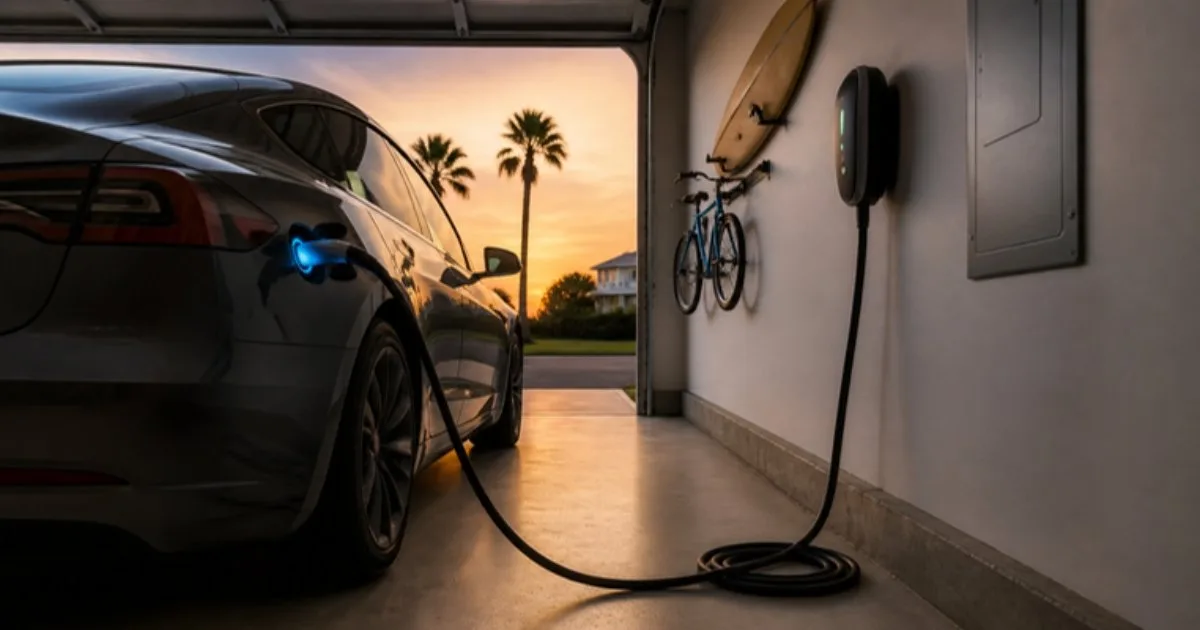
Put the charger where the charge port naturally lands when you park, as close to the panel as practical. Longer runs need larger wire, and in a slab-on-grade house the route goes along walls or through the attic, not under the floor.
Distance shapes the labor in any EV charger installation. Most Bay County homes sit on a slab with no crawlspace, so if the panel is across the house from the garage, the run may climb into the attic and back down, and a longer run calls for a bigger wire size to limit voltage drop.
Outdoor and driveway installs near the Gulf
If the car lives in the driveway, the charger lives in the salt air too. Outdoor EV charger installation calls for outdoor-rated equipment, weather-tight connections, corrosion-resistant hardware, and a cable holder that keeps the connector off the ground. Salt air eats exposed metal fast here.
Condos, townhomes, and shared garages
The parking space may be on a common meter, and the panel may sit in a locked electrical room. Before EV charger installation in a condo, get written approval from the HOA or condo association and find out how they want the power metered.
Do you need an EV charger permit in Bay County?
Yes. Adding a 240-volt circuit for a Level 2 charger is electrical work that typically needs a permit and inspection through the Bay County or city building department. A licensed electrical contractor should pull the EV charger permit.
The Department of Energy recommends safety-certified charging equipment and a certified electrical contractor. Unpermitted charger work tends to surface at the worst moment, such as a home sale, an insurance claim, or an overheated connection. A permitted EV charger installation also gives you a second set of eyes on breaker and wire sizing, grounding, GFCI protection, and mounting.
How does hurricane season change where you mount the charger?
Mount the charger high enough to stay clear of water if your garage takes on stormwater, and switch off its breaker before a storm if you live in a flood-prone area. Any charger that has been underwater needs an inspection before use.
Some garages near the bays and bayous see standing water in big storms, so flood risk belongs in the plan for EV charger installation in a low-lying garage. Mount it higher, keep the cable coiled on its holder, and keep connections up off the floor.
Before a named storm, unplug the car if you are evacuating and switch off the charger breaker. If the garage flooded, leave it off until a licensed electrician checks it. Our hurricane season home prep checklist for Bay County covers the rest of the house.
Is there still a federal tax credit for EV charger installation?
Not for new installs. According to the IRS instructions for Form 8911, the federal alternative fuel vehicle refueling property credit cannot be claimed for property placed in service after June 30, 2026, after Public Law 119-21 moved the end date up from 2032.
So EV charger installation done now, in late 2026, does not qualify for that credit. Call your electric utility and ask whether it offers any local rebate or EV rate before you start. We will not promise a rebate we cannot confirm.
If cost is the hurdle, especially with a panel upgrade, Frank Wood & Son Services offers financing through Hearth. Details are on our resources and financing page.
Frequently asked questions
How long does EV charger installation take?
A straightforward job with the panel near the garage is often finished in a single visit. Jobs that need a long attic wire run, a subpanel, or a panel upgrade take longer, and the permit and inspection schedule adds time on top. We give you a realistic timeline after the load calculation and site visit, not before.
Can I install a Level 2 charger myself?
We strongly advise against DIY EV charger installation. A Level 2 charger puts a heavy, continuous 240-volt load on your wiring for hours, and mistakes in wire size, breaker size, or connections can overheat and start a fire. It also needs a permit and inspection, and the Department of Energy recommends a certified electrical contractor.
What size circuit does a Level 2 charger need?
A 40 or 50 amp dedicated circuit is common for Level 2 home charging, but the right size depends on the charger, its setting, and what your panel can spare. The manufacturer’s instructions set the requirement. Your electrician should match the breaker and wire to that charger and your load calculation instead of picking a size by habit.
Is a NEMA 14-50 outlet good enough for an EV?
A NEMA 14-50 outlet works well for many plug-in Level 2 chargers when it is an industrial-grade receptacle on a properly sized circuit with the required GFCI protection. Cheap receptacles can wear and heat up under nightly heavy use. If the charger will stay in place for years, hardwiring is usually the more durable, lower-maintenance choice.
Will an EV charger raise my electric bill?
Yes, home charging adds to your electric bill because you are now buying the energy that used to come from the gas pump. How much depends on how far you drive and your utility’s rates. Ask your utility whether it has a time-of-use or EV rate plan, since overnight charging can sometimes cost less than afternoon charging.
Do I need a panel upgrade for an EV charger?
Not always. Many homes have enough spare capacity for EV charger installation on a Level 2 circuit, and a load management device can make room in others. A panel upgrade becomes necessary when the load calculation shows the service cannot safely carry the charger along with your AC, water heater, and other large appliances, or when the panel itself is old or failing.
Can a charger be installed outside in Panama City Beach?
Yes. Outdoor EV charger installation works as long as the charger and its connections are rated for outdoor use and installed to handle rain and salt air. Use corrosion-resistant hardware, weather-tight fittings, and a cable holder that keeps the connector off the ground. Homes close to the Gulf benefit from extra attention to enclosure ratings, because salt spray corrodes exposed metal quickly.
Do I need HOA approval for a charger in my condo garage?
In most condos and many townhome communities, yes, EV charger installation needs association approval. The association usually controls the common electrical rooms, the meters, and what can be mounted in shared garages. Get written approval and clear direction on metering before any work starts. Your electrician can then plan the circuit to meet both the association rules and the electrical code.
Is there a tax credit for home EV charger installation in 2026?
The federal refueling property credit cannot be claimed for property placed in service after June 30, 2026, according to the IRS Form 8911 instructions. A charger installed now does not qualify for it. Check with your electric utility for any local rebates or special EV rates, since those programs change often and are never guaranteed.
What happens to an EV charger if the garage floods?
Turn off the breaker and do not use the charger until a licensed electrician inspects it. Water and salt can damage internal parts and connections even after everything looks dry. Mounting the charger higher on the wall in flood-prone garages lowers the risk, and adding it to your hurricane shutdown routine keeps you from energizing wet equipment.
Book EV charger installation with a Panama City Beach electrician
Frank Wood & Son Services is a family-owned, Veteran-owned, licensed and insured company serving Panama City Beach since 1985. Our electricians handle EV charger installation from the load calculation and dedicated circuit to EV panel upgrades, subpanels, permits, and inspection. See our electrical services in Panama City Beach.
Call (850) 234-2168 or request an estimate online. We offer 24/7 emergency service, so if something sparks, trips, or overheats, you can reach us any hour.