What MERV Rating Should You Use in a Florida Home?
Most Panama City Beach homes do best with a filter somewhere between MERV 8 and MERV 13, and the right MERV rating depends less on the number on the box than on whether your return and blower can push air through it. Buy the densest filter on the shelf for a system that cannot handle it, and you trade cleaner air for a frozen coil and a sticky house.
A MERV rating is a number from a standard test that shows how well an air filter captures particles between 0.3 and 10 microns, and a higher number means better capture.
That definition comes from the EPA. What the box does not tell you is how a MERV rating plays out in a humid Gulf Coast house with attic ductwork, a dog, beach sand on the floor, and an AC that runs most of the year.
What does a MERV rating actually measure?
MERV stands for Minimum Efficiency Reporting Value. According to the EPA, it reports how well a filter captures particles between 0.3 and 10 microns, using a test method from ASHRAE, and higher values mean the filter catches more of those particles.
The EPA explains the scale in its page on what a MERV rating is. The test pushes particles of different sizes through a filter and measures how many get trapped.
In plain terms, here is what climbs as the number climbs:
- Low numbers stop lint, carpet fibers, and the bigger dust you can see floating in a sunbeam.
- The middle of the scale starts catching pollen, mold spores, dust mite debris, and pet dander.
- MERV 13 and up grab much finer particles, including some smoke and particles about the size of bacteria.
What a MERV rating does not measure matters too. It says nothing about odors, gases, or humidity. A great filter will not fix a musty smell from a wet duct or a house sitting at high humidity. That takes a different fix.
What is the best air filter for a home in Panama City Beach?
For most Bay County homes, the best air filter for home use is the highest MERV rating your system can move air through comfortably, often MERV 8 to 11 in a standard 1-inch slot and MERV 13 in a deeper media cabinet. The EPA suggests at least MERV 13, or the highest the fan and filter slot can accommodate.
People skip the second half of that advice. The EPA also recommends checking with an HVAC technician before you raise the MERV rating.
Decision table by MERV range
| MERV range | What it mostly catches | Best fit |
|---|---|---|
| 1 to 4 | Lint, carpet fibers, large dust | Basic equipment protection only; not much help for air quality |
| 5 to 8 | Dust, larger pollen, mold spores, some pet hair | Standard 1-inch slots in most homes; a safe everyday choice |
| 9 to 12 | Finer dust, most pollen, pet dander, some auto emissions | Homes with pets or mild allergies, if airflow allows |
| 13 to 16 | Fine particles including some smoke and bacteria-size particles | Allergy and asthma households, smoke drift, deep media cabinets |
| Above 16, or HEPA | Very fine particles | Usually a standalone purifier or dedicated add-on, not the main return |
Notice the “if airflow allows” note. That is the whole story.
Can a MERV 13 filter hurt your AC?
It can, if the system was not built for it. A MERV 13 filter is denser, and a dense 1-inch filter in an undersized return can choke airflow, freeze the evaporator coil, and weaken dehumidification. In a deep media cabinet, the same MERV rating usually works fine.
Every filter adds resistance, and denser filters add more. A 1-inch filter has very little surface area, so a high MERV rating in that thin slot forces the blower to pull harder through a tighter screen.
Here is what happens next in a Florida house:
- Airflow across the indoor coil drops.
- The coil gets colder than it should and can start to ice over.
- Ice blocks even more airflow, and cooling falls off.
- The system runs longer while pulling less moisture out of the air.
That last point matters more on the Gulf Coast than almost anywhere. Your AC is also your main dehumidifier. When airflow is wrong, the house can feel clammy at 75 degrees, and you start chasing mildew instead of comfort. If your system is running and the house still will not cool, our guide to an AC running but not cooling in Panama City Beach walks through the usual causes, and a clogged or overly dense filter is high on the list.
A MERV 13 filter is a great upgrade in the right system. It is a bad gamble in a cramped 1-inch return grille on an older air handler.
Is a 1-inch filter or a 4 to 5 inch media cabinet better?
A 4 to 5 inch media cabinet is better for most homes that want a higher MERV rating. The deeper, pleated filter has far more surface area, so it catches finer particles with less airflow restriction and usually lasts longer between changes.
The thin 1-inch filter in a return grille is cheap and easy, but it has very little material. A media cabinet mounts at the air handler and holds a thick pleated filter, often several inches deep. That extra surface lets a higher MERV rating move air with less effort.
Some practical points:
- Cost. Media filters cost more per filter but are typically changed less often than 1-inch filters.
- Installation. A media cabinet needs space at the air handler and a proper seal so air does not sneak around the filter.
- Fit. In many Bay County homes, the air handler sits in a closet, garage, or attic, and space decides what is possible.
If you want MERV 13 and only have a 1-inch slot, upgrade the housing first, then the MERV rating.
How often should you change an HVAC air filter in Florida?
Check it monthly and change it every one to two months during cooling season, more often with pets or dust. The Department of Energy says the same, and notes that replacing a dirty, clogged filter with a clean one can lower AC energy use by 5 to 15 percent.
The DOE guidance on maintaining your air conditioner assumes a cooling season. In Panama City Beach, cooling season covers most of the year, so the “season” schedule is closer to your normal routine. For an HVAC air filter in Florida, a few local factors speed things up:
- Spring pollen. The yellow film on cars in March and April is getting pulled into your returns too.
- Beach sand. Sand tracked in on feet and towels breaks down into fine dust that loads filters quickly.
- Pets. Dogs and cats shed year-round here, and the dander and hair build up fast.
- Smoke drift. Smoke from prescribed burns or wildfires inland sometimes drifts toward the coast, which is when a higher MERV rating earns its keep.
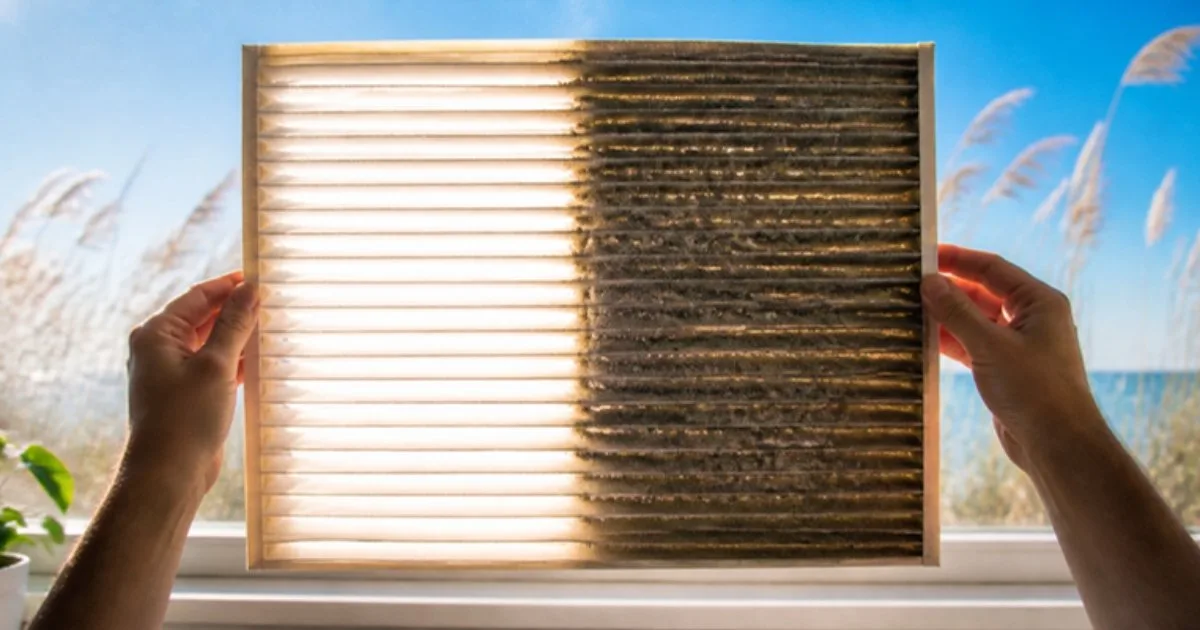
Media filters in a deep cabinet often last longer, but follow the manufacturer’s guidance and check them on the same schedule. A filter that looks gray and fuzzy is done, whatever the calendar says. Our list of AC maintenance tasks you can do yourself covers filter changes along with the other simple jobs.
Vacation rentals and second homes
Rentals are hard on filters. Guests run the AC hard, track in sand, and sometimes bring pets. A filter that lasts two months in a full-time home may be loaded in a few weeks of busy summer turnovers. Put filter checks on the cleaning checklist between guests. For second homes that sit empty, change the filter when you arrive and check it before you leave.
What are the signs your filter is too restrictive?
Whistling at the return grille, weak airflow from the vents, ice on the refrigerant lines or indoor coil, and a house that feels damp even when the thermostat is satisfied all point to too much restriction. A filter with a MERV rating too high for the system, or one that is simply overdue, causes the same symptoms.
Look and listen for these:
- Whistling or hissing at the return as air squeezes through.
- A filter bowing or sucked into the grille.
- Weak airflow at the supply vents, especially rooms far from the air handler.
- Ice on the copper lines outside or on the indoor coil.
- Longer run times and a higher power bill.
- Damp, sticky air or musty smells, a sign moisture removal has dropped.
If you see ice, turn cooling off with the fan on to thaw it, swap in a clean filter with a lower MERV rating, and call for service if it returns. Running a frozen system can damage the compressor.
When do whole-home air filtration, UV, HEPA, or dehumidifiers make sense?
Whole-home air filtration makes sense when a better filter alone cannot do the job, such as for allergy or asthma sufferers, homes near smoke drift, or houses with ongoing humidity and mold problems. UV, HEPA, and dehumidifiers each solve a different part of the indoor air problem.
A higher MERV rating is one tool, not always the right one.
- Whole-home air filtration. A properly sized media cabinet or upgraded filtration at the air handler, set up so the system can still breathe.
- HEPA purifiers. HEPA catches finer particles than the main return usually can handle. It is often added as a dedicated unit rather than forced into a standard return.
- UV lights. Installed near the indoor coil, UV is used to help limit growth on the wet coil surface. It does not replace a filter.
- Dehumidifiers. In a humid coastal home, a whole-home dehumidifier can control moisture when the AC is not running long enough to do it. If damp air is your main complaint, start with our tips on how to reduce indoor humidity.
- Ventilation. Controlled fresh air helps with stale air and odors.
Leaky ducts in a hot attic can pull in dust and insulation, so no filter can keep up. In that case, duct sealing, duct cleaning, and airflow balancing come first. Many homeowners need none of these add-ons. The right MERV rating, changed on time, in a system with sealed ducts, handles the job for a lot of houses.
Frequently asked questions
What MERV rating is best for a home with pets?
Filters rated MERV 8 to 11 handle pet hair and dander well in most standard systems, and MERV 13 is better if your system has a deep media cabinet or was set up for it. Pets load filters quickly in Florida, so check the filter monthly. Choose the highest rating your system can move air through without restriction.
Is MERV 13 too high for residential HVAC systems?
Not always. For home upgrades, the EPA suggests at least MERV 13, or the highest rating your fan and filter slot can accommodate. Many systems handle it well, especially with a 4 to 5 inch media cabinet. Some older systems with a small 1-inch return cannot, and a technician can tell you which one you have.
How often should I change my air filter in Panama City Beach?
Check it every month and plan to change a 1-inch filter every one to two months, sooner with pets, sand, pollen, or construction dust. Because the AC runs most of the year here, the cooling season schedule from the Department of Energy is close to a year-round routine. Deep media filters usually last longer, so follow the manufacturer.
Can a dirty air filter raise my electric bill?
Yes. A dirty, clogged filter makes the blower and the whole system work harder to move air. The Department of Energy says replacing a dirty, clogged filter with a clean one can lower air conditioner energy use by 5 to 15 percent. In a Florida home where the AC runs most months, that adds up over time.
What is the difference between MERV and HEPA?
MERV is a rating scale for HVAC filters based on how well they capture particles between 0.3 and 10 microns. HEPA is a separate, stricter efficiency standard for capturing very fine particles. HEPA filters are usually too dense for a standard return, so they are used in standalone purifiers or dedicated systems rather than in the main filter slot.
Does a higher MERV rating help with mold?
A denser filter can catch more airborne mold spores, but it does not fix the cause. Mold grows where moisture sits, such as a wet coil, a sweating duct, or a humid house. Controlling humidity, sealing leaky ducts, and keeping the coil clean matter more. A UV light or dehumidifier may help in some Gulf Coast homes.
Will a better filter help with wildfire smoke?
A MERV 13 filter catches some fine smoke particles, and the EPA points to MERV 13 as a good upgrade target. It only works when the system is running and air passes through the filter, so run the fan during smoky days. For heavy smoke, a portable HEPA purifier in the bedroom adds more protection.
Why is my return vent whistling after a new filter?
Whistling usually means the new filter is too restrictive for your return, often a high MERV rating in a thin 1-inch slot, or the filter is the wrong size and air is squeezing around it. Check the size, then try a slightly lower rating. If whistling continues, have a technician check the return and duct sizing.
Do washable filters work as well as disposable ones?
Most washable filters carry a low MERV rating and catch mainly larger dust. They must dry completely before going back in, which is tough in humid weather, and a damp filter can grow mold. For most Florida homes, a quality disposable pleated filter or a media cabinet is the better choice for indoor air quality.
Is whole-home air filtration worth it in Florida?
It can be for households with allergies, asthma, heavy pet dander, or smoke concerns, especially when a better filter alone causes airflow problems. A media cabinet or added filtration at the air handler cleans the air from every room. If your main issue is dampness or musty odors, humidity control and duct work usually come first.
Get help choosing the right MERV rating for your system
Frank Wood & Son Services is a family-owned, Veteran-owned, licensed and insured company that has served Panama City Beach and Bay County since 1985. We can check your return, blower, and ductwork, recommend the right MERV rating, and install whole-home filtration, UV and HEPA purifiers, dehumidifiers, or duct sealing and airflow balancing if your home needs it. See our AC services in Panama City Beach.
Call (850) 234-2168 or schedule a visit online. Ask about a seasonal tune-up, and remember we offer 24/7 emergency service when the AC quits on a July afternoon.