AC Running But Not Cooling? What Panama City Beach Homeowners Should Check First
It is the middle of July, the thermostat says 74, and your house feels like 84. The unit outside is humming along, air is coming out of the vents, but it just is not cold. On the Gulf Coast, that gap between what the thermostat promises and what you actually feel is more than annoying. It is the difference between a comfortable evening and a miserable, sweaty night.
The good news: an AC that runs but does not cool usually has a handful of common causes, and a couple of them you can rule out in five minutes before anyone picks up the phone. This guide walks through what to check yourself, what is almost certainly a job for a licensed technician, and how to keep the problem from coming back during the hottest stretch of a Panama City Beach summer.
Start with the three quick checks
Before assuming the worst, rule out the simple stuff. These three take a few minutes and solve a surprising number of “my AC is not cooling” calls.
- Check the thermostat. Make sure it is set to COOL, not just FAN, and that the target temperature is actually below the room temperature. If the fan is set to ON instead of AUTO, the blower runs constantly and pushes uncooled air between cycles, which feels exactly like warm air from the vents.
- Check the breaker. A central AC system has two power sources: the indoor air handler and the outdoor condenser. If only the indoor unit has power, the fan blows but nothing gets cooled. Look in your panel for a tripped breaker and reset it once. If it trips again, stop and call a pro, because that is a sign of an electrical fault, not a fluke.
- Check the air filter. A clogged filter is the single most common reason a system loses cooling power. When airflow is choked off, the system cannot move heat out of your home, and in humid climates the indoor coil can even freeze. More on that below.
If all three look fine and the house still will not cool, it is time to look at the usual mechanical culprits.
Why your AC runs but blows warm air
When the system is powered and the thermostat is right, an AC that will not cool almost always comes down to one of these issues.
A dirty filter or blocked airflow
Air conditioning works by moving warm air across a cold coil, pulling the heat out, and pushing the cooled air back into your home. Choke that airflow and the whole process stalls. A filter packed with dust, pet hair, and the fine sand that finds its way into every beach-town home restricts the air your system needs. Replacing a filter is cheap, fast, and often the fix. A good habit is to check it monthly and replace it every one to three months during heavy-use summer.
A frozen evaporator coil
Here is the counterintuitive one: an AC can stop cooling because part of it is covered in ice. When airflow drops or refrigerant is low, the indoor evaporator coil gets so cold that condensation freezes on it. A block of ice cannot absorb heat, so the air coming out turns warm even though the unit is straining. If you see ice on the copper lines or the indoor unit, turn the system off, set the fan to ON to help it thaw, and call a technician. Running a frozen system can damage the compressor, which is the most expensive part to replace.
Low refrigerant or a leak
Refrigerant is the fluid that actually carries heat out of your home, and it does not get “used up” in a healthy system. If you are low, you have a leak. Symptoms include warm air, hissing or bubbling sounds, and ice on the lines. Refrigerant handling is regulated and requires a licensed technician with the right equipment, so this is not a DIY repair. A pro will find the leak, fix it, and recharge the system to the correct level rather than just topping it off and sending you a bill again next month.
A dirty outdoor condenser
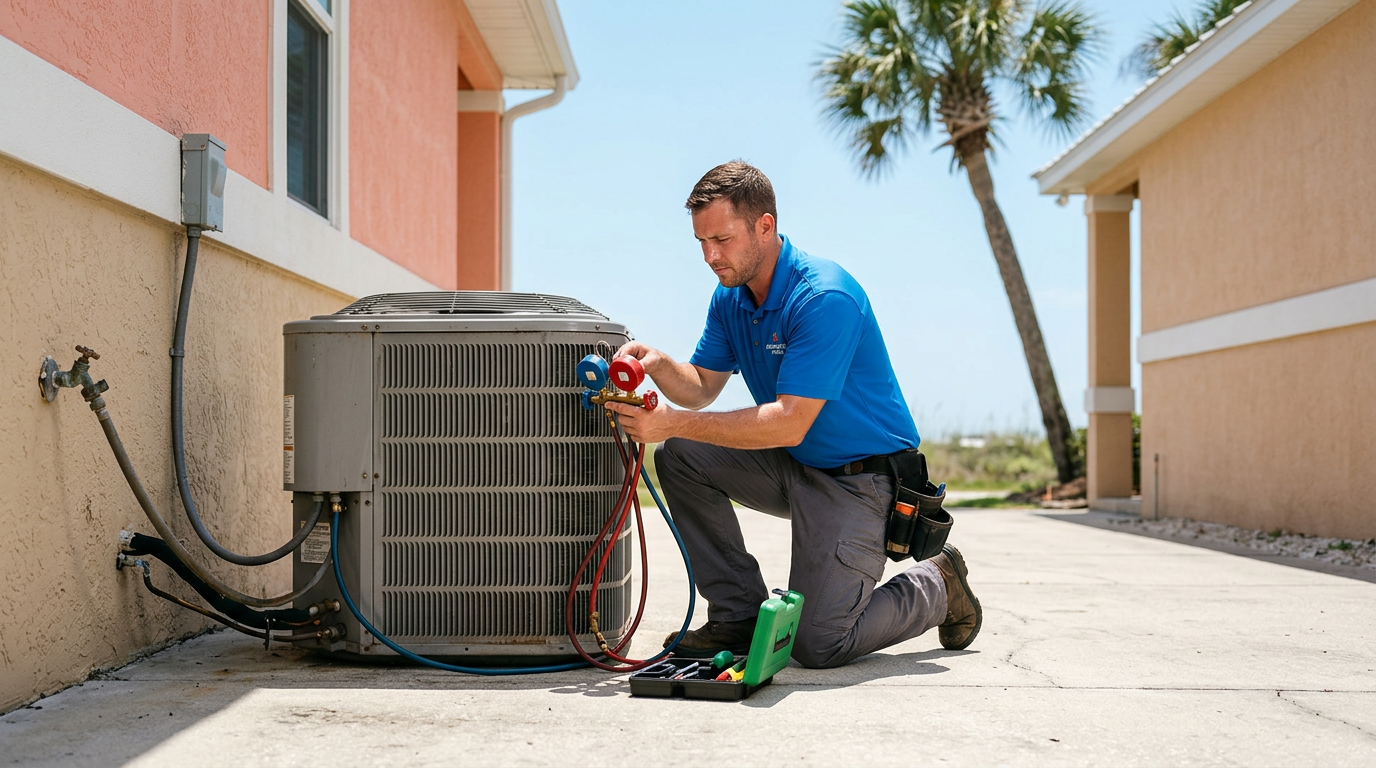
The outdoor unit dumps your home’s heat into the air, and it cannot do that if the coils are caked in grass clippings, pollen, salt residue, or dirt. Gently rinsing the outdoor unit with a hose (power off first) and keeping a two-foot clearance around it helps it breathe. In our salt-air environment, condenser coils corrode and clog faster than they do inland, which is why coastal systems need closer attention.
A failing capacitor or compressor
The compressor is the heart of the system, and the capacitor is the part that gives it the jolt it needs to start. When a capacitor weakens, the compressor may not engage even though the fan keeps spinning, so you get airflow with no cooling. You might hear a humming or clicking from the outdoor unit. These are electrical components that should be diagnosed and replaced by a technician, both for safety and to avoid misdiagnosing a cheap part as an expensive one.
The Panama City Beach factor
Coastal Florida is hard on air conditioners, and that changes how often these problems show up here.
Heat and runtime. Our systems run nearly nonstop from late spring into fall. More runtime means more wear, and small issues that would stay hidden in a milder climate get exposed under constant load.
Humidity. A properly working AC removes moisture as well as heat. When a system is undersized, low on refrigerant, or struggling with airflow, you feel it as a house that is technically cool but clammy. Persistent humidity indoors is often an early warning that something is off.
Salt air. Homes near the water deal with corrosion that inland homes never see. Salt accelerates wear on outdoor coils, electrical contacts, and fan components. This is the main reason a yearly tune-up matters more here than almost anywhere else.
When it is a DIY fix and when to call a pro
You can comfortably handle the basics: swapping the filter, resetting a breaker once, clearing debris from around the outdoor unit, and gently rinsing the condenser. Those are low-risk and often do the trick.
Call a licensed technician when you see ice on the system, suspect a refrigerant leak, hear humming or clicking with no cooling, have a breaker that keeps tripping, or have done the basics with no change. Refrigerant, electrical components, and compressor diagnostics require training, tools, and a license. In the Panama City Beach heat, a system limping along on a bad part will usually fail completely at the worst possible time, so an early service call is almost always cheaper than an emergency one.
How to keep it from happening again
Most no-cool emergencies are preventable. A simple routine goes a long way:
- Replace the air filter every one to three months in summer.
- Keep the outdoor unit clear of plants, debris, and clutter, with two feet of breathing room.
- Rinse the outdoor coils a couple of times during peak season.
- Schedule a professional tune-up once a year, ideally in spring before the heat sets in. A tune-up catches a weak capacitor, low refrigerant, or a dirty coil while it is still a small, cheap fix.
For a coastal home, that yearly visit is the highest-value thing you can do. It protects the most expensive parts and keeps the system pulling humidity out of your home all season.
Frequently asked questions
Why is my AC blowing hot air when it is turned on?
The most common reasons are a wrong thermostat setting (FAN instead of COOL or ON instead of AUTO), a tripped breaker on the outdoor unit, a frozen evaporator coil, or low refrigerant from a leak. Check the thermostat and breaker first, then look for ice on the lines. If those are clear, it usually points to a refrigerant or compressor issue that needs a technician.
Why is my air conditioner freezing up?
Ice forms when airflow drops or refrigerant runs low, making the indoor coil cold enough to freeze condensation. The usual triggers are a dirty filter, blocked vents, or a refrigerant leak. Turn the unit off, run the fan to thaw it, and have it checked before running it again, since running a frozen system can damage the compressor.
How often should I change my AC filter in Florida?
During heavy summer use, check it monthly and replace it every one to three months. Homes with pets, sandy beach traffic, or anyone with allergies should lean toward the shorter end. A clean filter is the cheapest insurance against lost cooling and frozen coils.
Is it bad to keep running my AC if it is not cooling?
Yes. Running a system that is frozen, low on refrigerant, or struggling electrically can turn a small repair into a compressor replacement. If basic checks do not restore cooling, turn it off and call a technician rather than letting it run.
How much does AC repair cost in Panama City Beach?
It depends entirely on the problem, from a low-cost filter or capacitor to a larger refrigerant or compressor repair. The honest answer is that a technician needs to diagnose it first. We give a clear estimate before any work begins, so there are no surprises on the bill.
Don’t sweat it out, get it fixed today
If your AC is running but your Panama City Beach home still will not cool, you do not have to tough it out through a July night. Our licensed technicians diagnose the real problem, explain your options in plain language, and quote the job before we start.
Call Frank Wood & Son Services at (850) 234-2168 for fast, 24/7 AC repair.
Learn more about our air conditioning repair and service in Panama City Beach, or request a service call and we will get a technician headed your way.