How to Prevent Frozen Pipes in Florida (Yes, It Happens Here)
It is the second week of January, the overnight forecast for Panama City Beach says 26 degrees with a north wind, and the neighborhood is treating it as a novelty. Somebody posts a photo of frost on a palm frond. Nobody is thinking about the water line running through an uninsulated attic.
Two mornings later, that same homeowner is standing in an inch of water in the hallway.
Here is what national advice gets wrong. Almost everything written about how to prevent frozen pipes was written for Minnesota, where the plumbing sits in a heated basement. In Bay County it sits in the attic, in exterior walls, and outdoors. You have to prevent frozen pipes differently here, and one twelve hour cold snap can do more damage in Panama City Beach than a week of cold does up north. Here is how to prevent frozen pipes on the Gulf Coast.
January 2025 ended the argument about whether Florida freezes
Florida freezes, hard and occasionally, with none of the habits northern states have built around it. A rare winter storm in late January 2025 set snow records across the Panhandle and knocked out power.
According to WUSF coverage of that winter storm, Milton recorded roughly 9.8 inches of snow, Pensacola picked up 8.9 inches and broke a record standing since 1895, and Crestview saw up to 9 inches. Duke Energy reported roughly 15,000 customers without power at the peak.
Snow on the beach makes the news. The plumbing damage shows up on an invoice two weeks later, and every hard freeze warning brings the same morning calls from Lynn Haven, Callaway, Parker, and Mexico Beach.
No Florida house is built to absorb that, and the work it takes to prevent frozen pipes is about ninety minutes in one afternoon. Put the plan to prevent frozen pipes on the same shelf as the hurricane season home prep checklist for Bay County. Same prep muscle, opposite season.
Why Panama City Beach homes are more vulnerable than northern homes
Northern homes are not tougher. Their plumbing sits inside the heated envelope of the house, while Florida homes route water through the coldest parts of the structure. That is why it takes more work to prevent frozen pipes here than in Ohio.
- Pipes run through uninsulated attics. Supply lines run overhead in slab homes, and an attic at 25 degrees is essentially outdoors.
- There is no basement to buffer. Slab-on-grade means no warm space underneath, so whatever the outside air does, the pipe feels.
- Exterior walls carry water lines. Kitchen and laundry connections sit behind two inches of insulation, sometimes none.
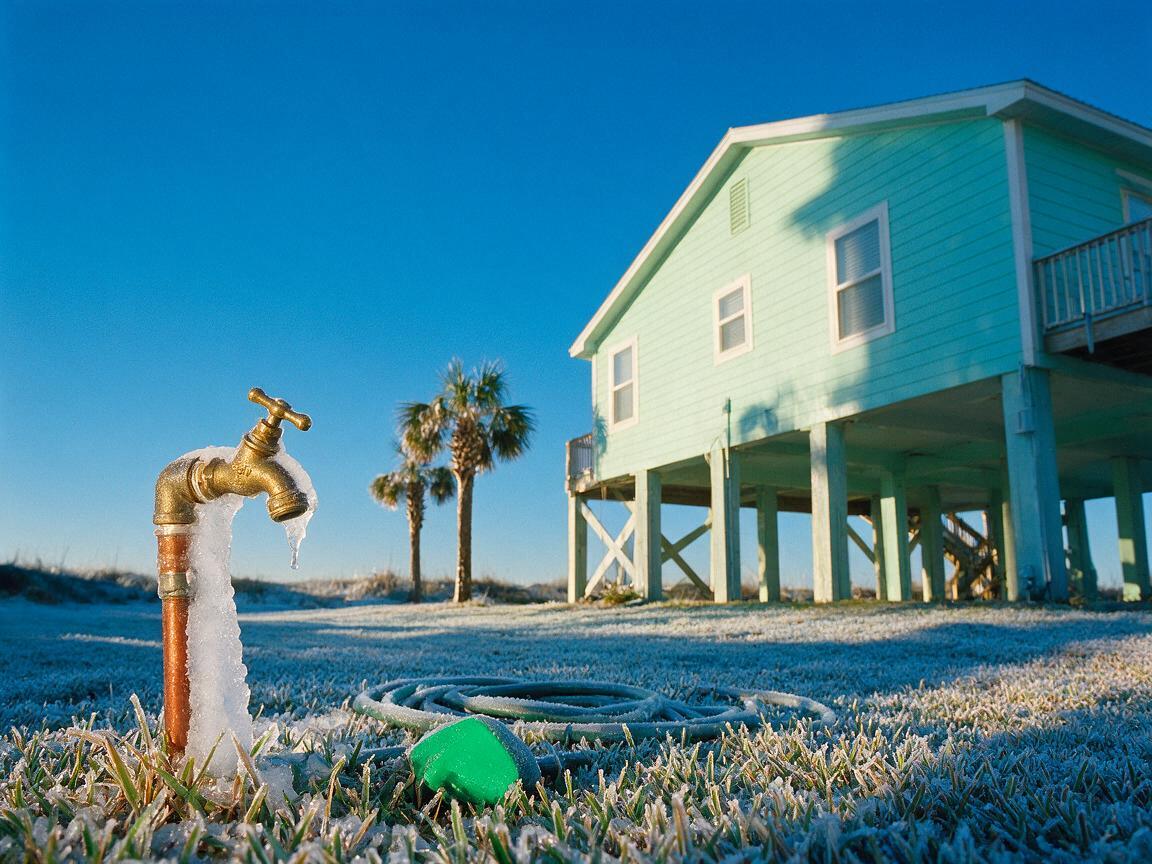
- Hose bibbs and irrigation backflow preventers are exposed. That brass backflow assembly is the component most often cracked after a Panhandle freeze.
- Pool equipment lives outdoors. Pumps, filters, and small diameter plumbing sit in open air, unprotected.
- Water heaters and tankless units hang in unconditioned garages. If you have wondered how long water heaters last here, a hard freeze in an open garage shortens the answer.
- Almost no local home was built with freeze protection in mind. No heat tape, no insulated chases, no frost proof sillcocks.
Add it up and a Bay County house takes damage at temperatures a northern home shrugs off. The checklist to prevent frozen pipes here looks nothing like a national one.
The temperature and time thresholds that actually matter
Water freezes at 32 degrees, but pipes do not fail at 32 degrees. What matters is how cold, how long, and how much wind crosses the exposed sections.
To prevent frozen pipes in Florida, treat 28 degrees sustained for four hours as the point where exposed plumbing is at real risk, and treat wind above 10 mph as an accelerator that halves that window.
- 32 to 29 degrees before dawn. Low risk for interior plumbing. Cover the hose bibbs anyway.
- 28 degrees or lower, sustained overnight. The real danger zone, and where the work you did to prevent frozen pipes earns its keep. Attic runs and north facing walls go first.
- 25 degrees or lower with wind. Assume everything exposed is at risk, including irrigation, pool equipment, and garage plumbing.
Wind is the part people underestimate. Still air forms an insulating layer around a pipe, and a 15 mph north wind strips it away. That is why north and west walls fail first, and why any effort to prevent frozen pipes starts on the windward side.
The three tier plan to prevent frozen pipes
Split the work into three tiers: fall prep, the day a freeze warning is issued, and the power outage itself. Finish tier one in November and tier two takes twenty minutes.
| Tier | When | What you do |
|---|---|---|
| Tier 1: Before the season | November | Insulate hose bibbs, drain and disconnect hoses, wrap the irrigation backflow preventer, sleeve exposed attic and garage runs, label the main shutoff |
| Tier 2: Day before a freeze | 12 to 24 hours out | Drip the correct faucets, open cabinet doors on exterior walls, hold the thermostat at 68 degrees, drain irrigation, cover pool equipment |
| Tier 3: If the power goes out | During the freeze | Shut the main, drain the lowest faucets, keep interior doors open, no generator or grill indoors, inspect everything when power returns |
Tier one decides the outcome. Everything you do to prevent frozen pipes on the night of a freeze is damage control for work skipped in the fall.
Here is the checklist to prevent frozen pipes the evening a freeze warning is posted.
- Find and turn the main water shutoff, in the dark, in under a minute.
- Disconnect and drain every garden hose, which otherwise traps water against the bibb.
- Cover each hose bibb with a foam faucet cover.
- Wrap the irrigation backflow preventer and shut off the irrigation zones.
- Open cabinet doors under every sink on an exterior wall.
- Hold the thermostat at a steady 68 degrees and cancel the night setback.
- Start the correct faucets dripping, hot and cold, before bed.
- Cover the pool equipment and set the pump per your builder guidance.
- Stage a flashlight, a shutoff key, and a 24/7 plumber number for 3 a.m.
Which faucets to drip, and how to drip them correctly
Not every faucet, and not a drop every few seconds. You want continuous movement in the longest exposed runs, because moving water is harder to freeze and an open faucet gives expanding ice somewhere to push. In most Panama City Beach homes that means the kitchen sink, the laundry tub, the bathroom farthest from the water heater, and any fixture on a north facing wall.
- Open both the hot and the cold side. Hot lines freeze too, and the run from a garage mounted water heater is often the most exposed pipe in the house.
- Aim for a steady stream the width of a pencil lead. A slow drip is not enough movement.
- Leave it running all night. The coldest hour is usually between 5 and 7 a.m.
- Open the cabinet doors so room air can reach the pipe in the wall cavity.
Done correctly, dripping is the cheapest way to prevent frozen pipes overnight.
How to prevent frozen pipes in a vacant condo or second home
This is the Panama City Beach problem national guides never address. In January much of the beach housing stock is empty, the owner is out of state, and a line that lets go at 4 a.m. runs for days before anyone notices.
In an unoccupied property you do not prevent frozen pipes by dripping. You prevent frozen pipes by taking the water out of the building.
- Shut off the main supply and leave it off for the vacancy.
- Open every faucet and flush every toilet to drain the system to atmospheric pressure.
- Drain the water heater or set it to vacation mode, and cut its power.
- Pour RV antifreeze into each drain trap and toilet bowl so traps do not freeze or evaporate dry.
- Install a freeze alert smart water sensor near the water heater and laundry connections. A sensor that texts you at 3 a.m. is the highest return purchase here.
- Add an automatic shutoff valve on the main. It closes the water when it detects continuous flow, turning a four day flood into a four gallon spill.
- Hold the thermostat at 60 degrees, never fully off, and confirm your heating system is running the way it should before you leave.
- Give a local contact a key to walk the unit after any freeze warning.
For rentals, this protocol belongs on the housekeeping checklist from December through February.
What to do if a pipe is frozen but has not burst
If a faucet gives you nothing on a cold morning, there is ice in the line and a short window before pressure splits the pipe. Acting in that window is the last chance to prevent frozen pipes from becoming burst pipes.
Never use a torch, a propane heater, or any open flame to thaw a pipe. That is how attic fires start, and it can boil water inside a closed section and rupture it.
- Open the affected faucet, hot and cold, so melting water can escape.
- Apply gentle heat from the faucet back toward the frozen section. A hair dryer on low, a heating pad, or hot towels all work.
- Warm the room with a space heater kept clear of anything flammable.
- If the frozen section is behind a wall or in the attic, stop and call a plumber.
If flow does not return within an hour, treat it as a call.
What to do the moment a pipe bursts
Nothing at this point will prevent frozen pipes from doing damage, but the first sixty seconds decide how much. Water first, electricity second, phone third.
- Shut off the main water valve. This is why tier one includes testing it.
- Kill power to the water heater at the breaker. An electric heater that drains while energized destroys its elements.
- Cut power to any circuit near standing water, if you can reach the panel safely and dry.
- Open the lowest faucets to drain the remaining pressure.
- Photograph everything for the insurance claim.
- Call for Panama City Beach plumbing services and start drying immediately.
Repairs on a pressurized supply line are not a homeowner project, and Florida requires a licensed contractor. Confirm anyone you hire through the Florida DBPR Verify a Licensee tool.
The post freeze inspection most people skip
Many leaks appear on the thaw, not during the freeze, when the ice plug melts and pressure returns to a pipe that already split. Walk the house once temperatures climb back above 40 degrees.
- Ceilings and interior wall tops for stains, sagging, or a drip sound in the attic.
- The water meter. Shut every fixture off and watch it for fifteen minutes. Movement means water is going somewhere.
- Every hose bibb, the irrigation backflow preventer, and the pool pump, filter, and PVC unions.
- The water heater connections and under every sink and behind the washer for pooling or swollen cabinet bases.
If you find wet material, dry it fast. EPA guidance on mold and moisture is clear that mold will usually not grow if wet materials are dried within 24 to 48 hours, and Gulf Coast humidity does not make that window generous. The habits that prevent frozen pipes apply to the cleanup: move faster than the problem.
Frequently asked questions
At what temperature do pipes freeze in Florida?
Pipes rarely fail at 32 degrees. The danger zone starts near 28 degrees sustained for four or more hours, and drops lower with wind. In Bay County you prevent frozen pipes by watching duration and wind exposure, not just the overnight low temperature.
Should I drip every faucet in the house during a freeze?
No. To prevent frozen pipes you only need the fixtures on the longest runs of exposed or exterior wall pipe: the kitchen sink, the laundry connection, and the bathroom farthest from the water heater. Open both hot and cold, at a stream the width of a pencil lead.
How do I protect pool equipment and irrigation during a Panhandle freeze?
Shut off and drain the irrigation system, then wrap the backflow preventer with insulation and a weatherproof cover, since that brass assembly is the component most often cracked after a freeze. For the pool, follow your builder guidance on running the pump during a hard freeze.
What should I do if my pipes are frozen but have not burst?
Open the affected faucet on both hot and cold so melting water can escape, then apply gentle heat with a hair dryer on low, a heating pad, or hot towels, working from the faucet toward the frozen section. Never use a torch or any open flame.
Can I leave my Panama City Beach condo empty during a freeze?
Yes, but winterize it first. The way to prevent frozen pipes in an empty unit is to remove the water: shut off the main, open every faucet, flush the toilets, and drain the water heater. Add a freeze alert sensor or an automatic shutoff valve.
How much water comes out of a burst pipe?
A half inch supply line can release several hundred gallons per hour at normal residential pressure. In an occupied home you catch it in minutes. In a vacant Panama City Beach condo in January it can run for days, which is why remote monitoring matters here.
Get ahead of the next Bay County freeze
The best time to prevent frozen pipes is a mild Saturday in November, not the night the freeze warning drops. Foam covers, pipe sleeves, a labeled main shutoff, and a wrapped backflow preventer cost far less than one hour of emergency water extraction.
Frank Wood & Son Services has handled plumbing for Panama City Beach, Panama City, Lynn Haven, Callaway, and Mexico Beach since 1985. Family owned, Veteran owned, licensed and insured, with 24/7 emergency service.
Call (850) 234-2168 or contact Frank Wood & Son Services to book a freeze readiness inspection. We will help you prevent frozen pipes before the next cold front, and we will be there if one has already given way.