Is a Tankless Water Heater Worth It in Panama City Beach?
If your old water heater is on its last legs, someone has probably told you to go tankless. For a lot of Panama City Beach homes that is good advice. For some it is not, and the difference usually comes down to how much hot water you use at once, what fuel you have, and whether your electrical panel can handle the load.
A tankless water heater heats water only when a tap opens, so it skips the standby heat loss of a tank, lasts longer, and saves space, but it delivers a limited flow at one time.
Frank Wood & Son Services installs both tank and tankless units across Panama City Beach and Bay County, and we have since we started as a plumbing company in 1985. Here is how we size up the choice, including when we tell people to stay with a tank.
How does a tankless water heater work?
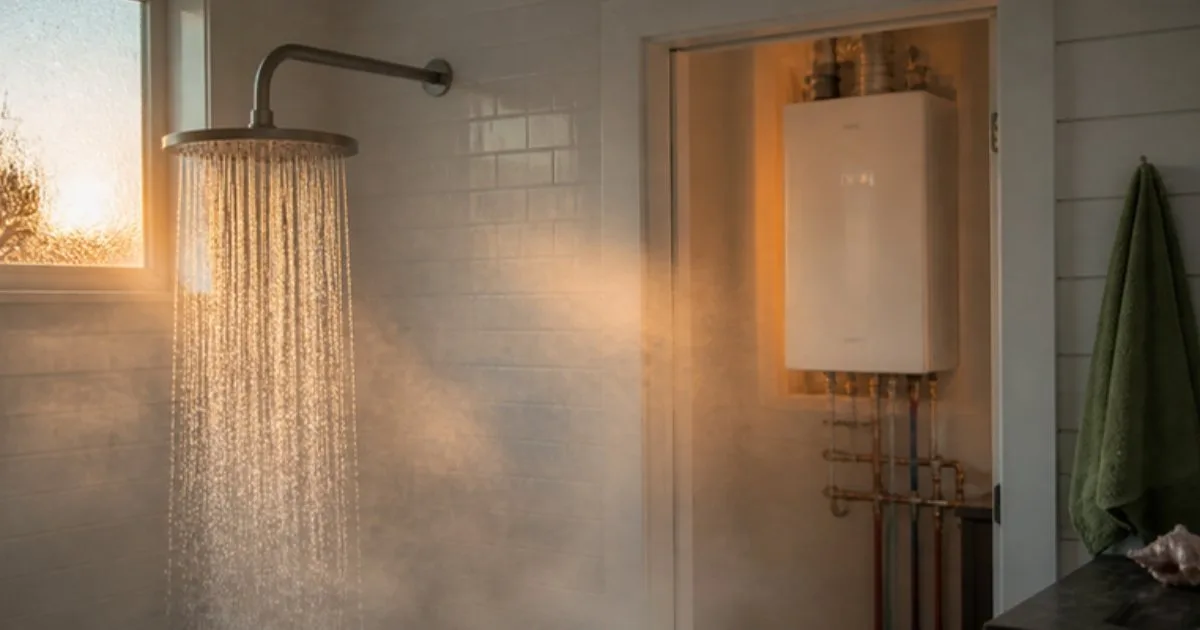
A demand-type unit uses a gas burner or electric elements to heat water as it flows through. Nothing is stored, so nothing sits in a tank losing heat all day.
Open a hot tap and a flow sensor fires the tankless water heater. Close the tap and it shuts off.
A storage tank works the other way. It keeps a reserve hot around the clock, often 40 or 50 gallons, and reheats whenever the water cools. That reserve is why a tank can cover a big burst of demand. It is also why a tank burns energy while everyone is at work or the beach house sits empty.
The tradeoff is flow rate. A tankless unit can only heat so many gallons per minute. Run two showers, the dishwasher, and the washing machine together, and a single unit can fall behind, so the water at the far shower gets lukewarm.
Tankless vs tank water heater: what are the real differences?
In the tankless vs tank water heater comparison, tankless wins on efficiency, lifespan, and space, while a tank wins on upfront simplicity, surge capacity, and easy replacement. Your household decides which of those matters more.
Here is the side by side we walk homeowners through:
| Factor | Tankless | Storage tank |
|---|---|---|
| How it heats | On demand, as water flows | Keeps a reserve hot all day |
| Energy efficiency | Higher, especially in lower-use homes | Loses heat on standby |
| Life expectancy | More than 20 years for most units | About 10 to 15 years |
| Hot water supply | Endless, but limited flow at one time | Large burst, then runs out |
| Space | Small, wall-mounted | Floor space in a closet or garage |
| Upfront install | Often needs gas, venting, or electrical upgrades | Usually a straight swap |
| Routine upkeep | Annual descaling recommended | Periodic flushing for sediment |
| Power outage | Needs electricity, even gas models | Gas tanks with standing pilots often still work |
Notice the install row. A tank for tank swap is usually simple. Switching can mean a bigger gas line, new venting, a dedicated circuit, or a panel upgrade. That work is where the true cost of switching shows up.
How much energy does a tankless water heater save?
According to the U.S. Department of Energy, demand-type water heaters can be 24 to 34 percent more energy efficient than storage tanks in homes that use 41 gallons or less of hot water a day. In homes that use a lot, around 86 gallons a day, the gain drops to 8 to 14 percent.
Those numbers come from the Department of Energy’s Energy Saver page on demand-type water heaters. A tank wastes the most energy when hot water sits unused. Smaller households use less hot water, so more of their tank energy goes to standby loss, and the switch helps them more.
A couple who works all day, a retiree living alone, or a second home that sits empty for weeks at a time are strong fits. A busy family of six still saves, just less.
Savings also depend on your fuel and habits. Endless showers can eat into those savings.
What is the real tankless water heater lifespan?
The Department of Energy says most tankless units have a life expectancy of more than 20 years, compared with 10 to 15 years for a storage tank. Reaching that full tankless water heater lifespan depends heavily on maintenance.
Longer life is one of the strongest arguments for going tankless. Over 20 years, a tank owner may buy two water heaters. An owner who maintains a tankless water heater may buy one.
If you are trying to judge how much life your current tank has left, our post on how long water heaters last covers the warning signs and the factors that shorten a tank’s life on the Gulf Coast.
Why does descaling matter so much in Bay County?
Descaling matters because minerals in the water build up inside the heat exchanger of a tankless unit, which cuts efficiency and can trip error codes or shut the unit down. Flushing it once a year keeps scale from getting a foothold.
Water heats fast through narrow passages, which is exactly where dissolved minerals drop out. The scale acts like insulation, the burner or elements work harder, and eventually the tankless water heater throws a code.
Descaling is a straightforward service. The unit is isolated with service valves, and a descaling solution is pumped through the heat exchanger for a set time, then flushed out. Most owners have a tankless water heater descaled once a year. Homes with a softener or lighter usage may stretch it a little. Homes with heavy use or harder water should not.
A unit that never gets flushed will not reach its potential life. If a unit is put in without isolation valves, ask why, because those valves are what make annual service quick.
Gas tankless or electric: which makes sense here?
Gas tankless units usually handle higher flow and suit larger households, but they need correct gas line sizing and proper venting. Electric tankless units are simpler to vent but can demand very large amperage, sometimes enough to require a panel upgrade.
What gas tankless needs
A gas tankless water heater burns far more fuel when it fires than a tank burner does, so the line that fed the old tank is often too small. Undersized pipe starves the unit, and it cannot hit its rated output.
Venting is the other piece. Tankless units need venting rated for their exhaust, and the route and termination have to meet the manufacturer’s requirements and code. In a garage or utility closet that often means a new path through a wall or roof. Frank Wood & Son Services handles the gas line installation as part of the job, so the fuel supply and the unit are sized together.
What electric tankless needs
A whole-house electric tankless water heater can draw very large amperage, often on multiple 240-volt circuits. Many older Bay County homes do not have that much spare capacity. If your panel is already crowded or the house has a smaller service, an electric unit may mean a panel upgrade before anything else.
Our article on the signs you need an electrical panel upgrade explains what to look for. Because we do plumbing and electrical under one roof, we can check both sides of an electric install on the same visit.
Does a tankless water heater make sense for vacation rentals and condos?
Often it does. A vacation rental with back-to-back guest showers benefits from endless hot water, and a condo benefits from the space a wall-mounted unit saves, as long as the unit is sized for peak demand.
A rental that sleeps ten is the classic problem. Everyone comes off the beach at the same time, and the last person in line for a shower gets cold water from a tank. A properly sized tankless water heater, or two units working together, keeps up with that rush without running out.
A small unit in a big rental gives you endless lukewarm water and bad reviews. We size by how many fixtures will run at once, not by the number of bedrooms alone.
In beach condos, closets are small and hauling a tank out several floors up is a real job, so a compact wall-mounted tankless water heater frees up space. Building rules on venting and gas can limit options, so check with the association before you plan anything.
Second homes gain too. A tank keeps heating water no one is using between visits.
When is a tank water heater still the better buy?
A tank is still the better buy when your current setup is simple and working, when the upgrades for tankless would be extensive, or when your household needs big bursts of hot water that would take two tankless units to cover.
Stay with a tank in these cases:
- A straight swap on a tight budget. A new tank in the same spot with the same connections is the least expensive way to get hot water back today.
- Major gas, venting, and electrical work. If the house needs a new gas line, new venting, and a panel upgrade, the payback stretches out a long way.
- Heavy hot water use at once. A big family running several fixtures at the same time may need two tankless units to match one large tank, and the efficiency gain is smaller in high-use homes anyway.
- A sale coming soon. If you will not be in the house long, the longer life of a tankless unit mostly benefits the next owner.
- Storm outages worry you most. A tankless water heater needs electricity for its controls, igniter, and fan, even when it burns gas, so it quits when the grid goes down after a hurricane. Some gas tanks with standing pilots keep heating without power. With a whole-home generator, this point mostly goes away.
None of that makes a tankless water heater a bad product. It is simply a better fit for some houses than others.
If the numbers favor tankless but the upfront cost is the hurdle, financing through Hearth can spread the install out over time.
Frequently asked questions
Is a tankless water heater worth it in Florida?
For many Florida homes, yes, especially smaller households, second homes, and condos where efficiency, space, and long life matter most. It is less worth it when the install needs a new gas line, venting, and a panel upgrade, or when a large family runs many fixtures at once. A local plumber can tell you which side of that line your house falls on.
How long does a tankless water heater last?
The U.S. Department of Energy reports that most tankless units have a life expectancy of more than 20 years, compared with 10 to 15 years for a storage tank. Reaching that range depends on regular maintenance. Annual descaling, clean inlet filters, and correct installation all help a unit last. Skipping service is the most common reason units fail early.
How often should a tankless unit be descaled?
Most homeowners should have a tankless unit descaled once a year. Minerals in the water collect inside the heat exchanger, which lowers efficiency and can trigger error codes or shutdowns. Homes with heavy use or harder water may need it more often, while homes with a water softener may stretch the interval. Isolation valves on the unit make the service quick.
Can one tankless unit run two showers at once?
It depends on the unit’s flow rating and the temperature of the incoming water. Many whole-house units can handle two showers, but adding a dishwasher or washing machine at the same time can outrun a single unit. If your household regularly runs several fixtures at once, a larger unit or two units working together may be the better plan.
Does a gas tankless water heater work without power?
No. A gas tankless water heater still needs electricity for its controls, igniter, and fan, so it stops working during a power outage. That matters after hurricanes, when outages can last days. A whole-home generator can keep it running. Some gas storage tanks with standing pilot lights can still make hot water without power, which is one reason some owners stay with a tank.
Do I need a panel upgrade for an electric tankless unit?
Sometimes. Whole-house electric tankless units can draw very large amperage, often across multiple 240-volt circuits. Many older homes do not have that much spare capacity, especially with central AC, an electric range, and a dryer already on the panel. A licensed electrician should check your service size and available space in the panel before you buy an electric unit.
Is tankless better for a vacation rental?
Often, yes. Vacation rentals see back-to-back guest showers, and a properly sized tankless system keeps up without running out the way a tank can. It also stops heating water while the property sits empty between bookings. The key is sizing for peak demand, since a small unit in a large rental delivers endless lukewarm water and unhappy guests.
What size gas line does a tankless unit need?
That depends on the unit’s input rating, the length of the gas run, and the other gas appliances in the house. A gas tankless unit burns much more fuel at once than a tank, so the line that fed an old tank is often too small. A plumber should calculate the load and the pipe size before installation so the unit gets enough gas.
Can I install a tankless water heater myself?
It is not a good idea. Installing a tankless unit often involves gas piping, venting, electrical circuits, and permits, and mistakes can create carbon monoxide, gas leak, or fire hazards. Manufacturers may also require professional installation for warranty coverage. A licensed plumber can size the unit correctly, handle the permit, and make sure the gas, venting, and water connections all meet code.
Does tankless save money for a big family?
It can, but the savings are smaller. The Department of Energy says that in homes using around 86 gallons of hot water a day, demand water heaters are 8 to 14 percent more efficient than tanks, compared with 24 to 34 percent in lower-use homes. A big family may also need two units to meet peak demand, which adds to the upfront cost.
Talk to a Panama City Beach plumber about a tankless water heater
If you are weighing tankless against a new tank, we will look at your hot water use, your gas or electrical service, and where the unit would go, then give you a straight recommendation. Frank Wood & Son Services is family-owned and Veteran-owned, licensed and insured, and has served Panama City Beach since 1985. Learn more about our water heater installation and plumbing services.
Call (850) 234-2168, available 24/7 for emergency service, or schedule a water heater consultation online and get a tankless water heater recommendation built around your house.